Racine Epoxy Flooring brings more than 20 years of epoxy flooring in Zion and across the region to rooms where the floor has a rulebook behind it. Child care classrooms are one of those rooms, because a licensed center’s floor is held to a written state standard rather than to taste. We plan these floors around what that standard asks of them and what a concrete slab can honestly deliver.
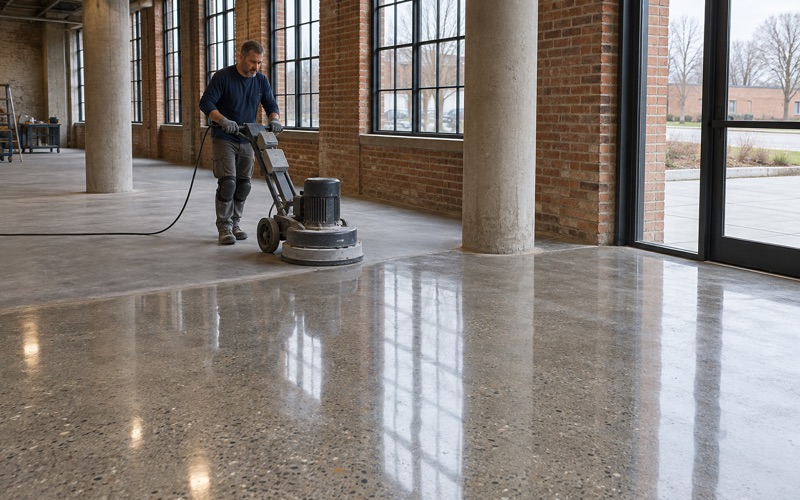
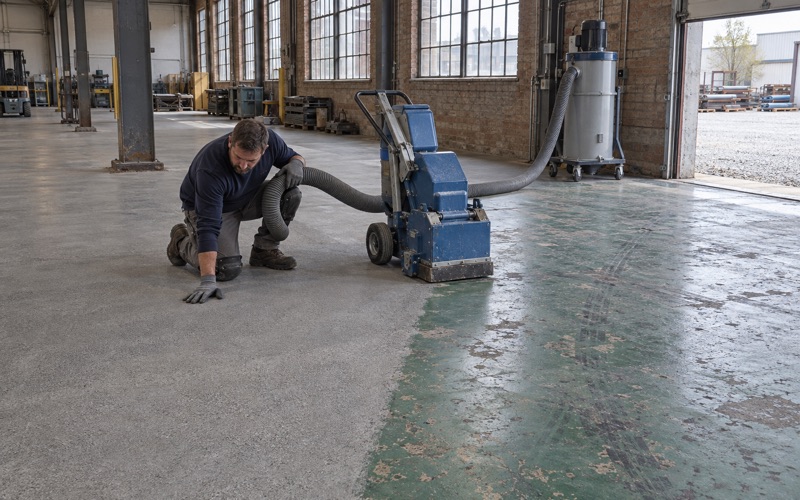
That starts with the slab itself. Before we quote a coating, we look at the cracks, the joints and whatever old coating or tile adhesive is still bonded, and we tell a director plainly when the concrete needs repair first. Then we open the surface mechanically with a diamond grinder or a shot blaster. We do not acid etch a classroom floor, or any floor.
Moisture is the part we take most seriously on a ground-floor classroom. Testing is written into our scope as its own line, not offered after a coating has already lifted. The proposal also names the product, the system build and the finished thickness, so a center owner can check what was quoted against what went down.
Child Care Floors on Sheridan Road and the State’s Floor Line
Where the rule comes from
Zion is a Lake County city of 24,655 people at the 2020 census, and its child care centers sit along streets like Sheridan Road. Martha’s Daycare North, at 2682 Sheridan Rd, is one of them, listed as a child care center. We name it as a place on the map, not as a client, and we have not read its license or seen its floors.
The standard that governs licensed centers is 89 Ill. Adm. Code 407.370, the physical plant section of the Illinois Licensing Standards for Day Care Centers. Its floor language is short. Subsection (e)(2) says the floors and floor coverings shall be washable and free from drafts, splinters, and dampness.
Reading the three conditions
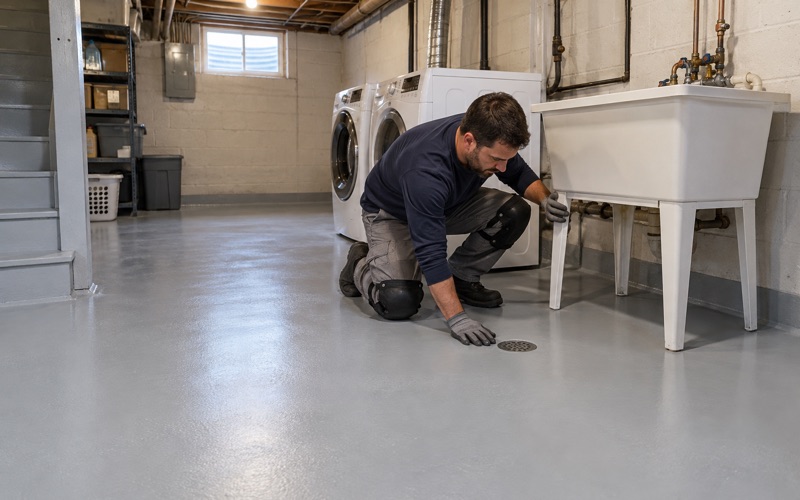
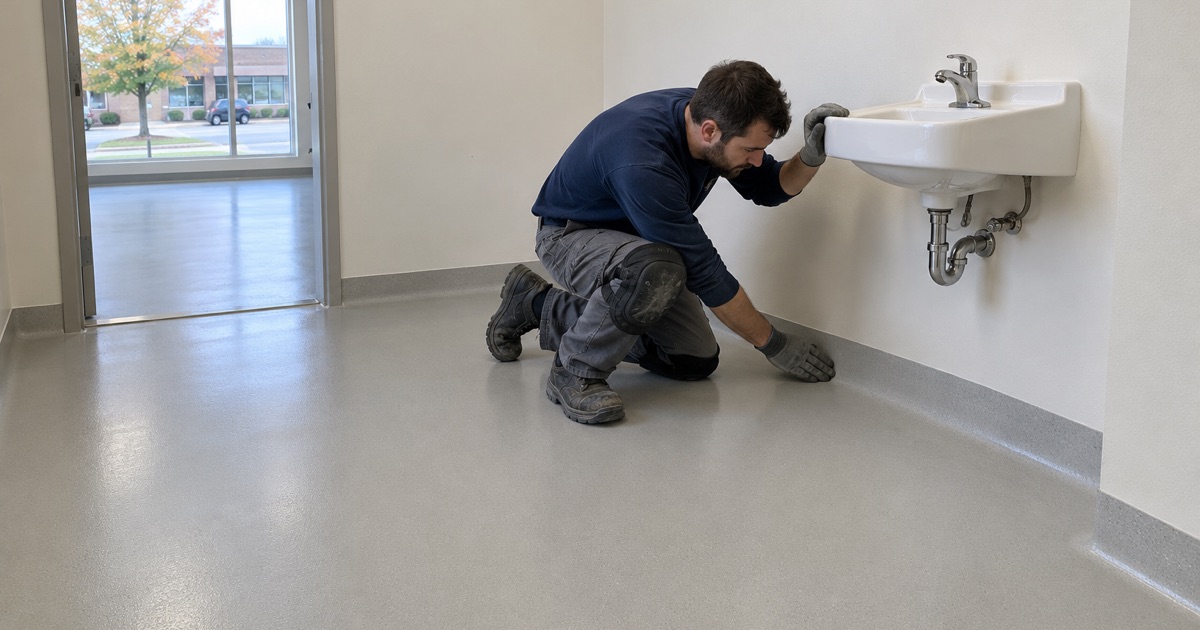
Washable and splinter-free are surface questions, and a seamless resin floor answers them well. A properly built 100% solids epoxy has no grout lines, no wood grain and no seams for spills to settle into, and it wipes down with ordinary cleaners. A worn vinyl tile with lifting edges, or a sealed wood floor that has started to check, is a harder fit for that sentence.
Drafts are mostly a building question rather than a coating question, and we say so rather than sell around it. Dampness is different. It lives in the slab under the floor covering, and no topcoat makes a damp slab dry, so that word governs how we plan the whole job.
What a coating can and cannot promise
The state licenses child care centers, and the licensing agency decides whether a room meets its standard. No floor coating carries an approval that makes a room licensable, and we do not describe ours that way. What we can do is build a floor whose surface matches the rule’s wording and document the slab conditions under it.
That documentation matters when a center is renovating a room or converting a commercial space. A written record of the moisture readings, the surface profile and the products used gives an owner something concrete to show an inspector who asks how the new floor was prepared.
Looking for epoxy-flooring closer to Bay View? See Epoxy-Flooring in Bay View.
Infants, Toddlers and the Wet Corners
Ground level means the slab
Subsection (c) of the same rule houses infants and toddlers at ground level unless a fire inspector approves an exception. In a single-story building, or the first floor of a larger one, ground level usually means a concrete slab poured directly on soil. Those are the rooms where the youngest children crawl, sit and play on the floor for much of the day.
A slab on grade is also the floor most exposed to moisture moving up from below. So the rooms the rule sends the babies to are the same rooms where a coating is most likely to meet damp concrete. We treat infant and toddler rooms as the first place to test, not the last.
Water play and painting areas
Subsection (d)(5) addresses noise. If a center uses carpet to control sound, carpet is not required in water play, painting and similar areas. Those corners are where water, tempera paint, glue and clay land on the floor every day, and a hard, washable surface is the practical answer.
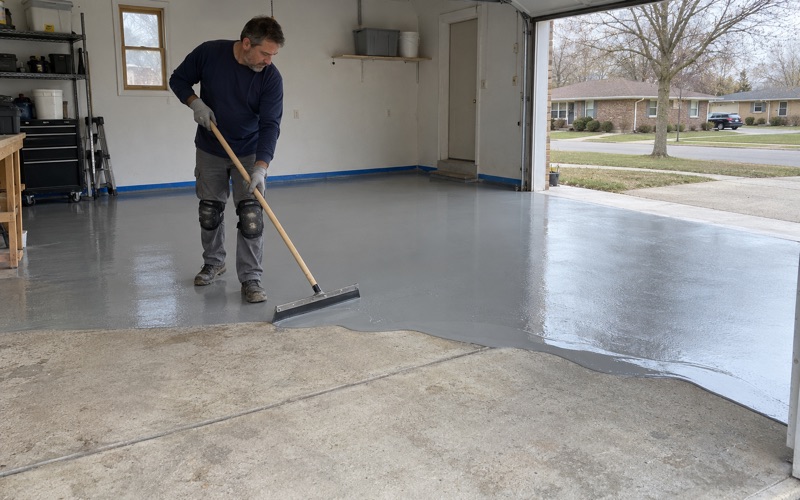
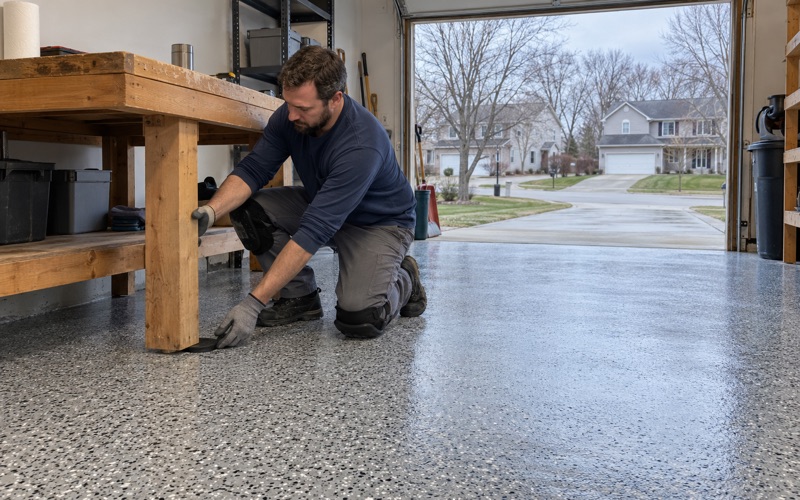
For those zones we usually build a 100% solids epoxy base with a broadcast for texture. A vinyl flake broadcast hides wear and gives a little grip, while a quartz aggregate broadcast gives more where water stands. The amount of texture is a trade-off, because a heavier profile is harder to mop, and we talk through that with the director before choosing one.
Edges, transitions and cleanup
Where a coated wet corner meets carpet or another floor, the edge has to be finished cleanly so it does not catch a toe or collect grime. We cut and terminate the coating at a straight line and protect the transition rather than feathering resin out to nothing. Along walls, we can carry the coating up a short distance so mop water does not sit in the joint.
Topcoat choice follows how the room is cleaned. A polyaspartic or polyurea topcoat stands up to frequent wet mopping and resists staining from paint and markers. Whichever finish we use, the proposal states it by name and the warranty states what it does not cover.
Testing a Damp Slab Before Anything Is Sealed
Why a sealed floor blisters
Concrete gives off moisture vapor when the soil below is wetter than the room above. A bare slab lets that vapor escape. A sealed resin floor traps it at the bond line, where vapor pressure can push the coating up into blisters, and the floor stays damp underneath the film.
That is the failure the state’s word “dampness” warns against, and it is why a coating cannot fake that part of the rule. If the slab is wet, the floor is not free from dampness just because the surface looks glossy. The honest sequence is to test the slab before sealing it, then decide what system it can carry.
The tests we run
Our first look is often an ASTM D4263 plastic sheet test, a taped square of polyethylene that shows whether moisture collects under it overnight. It is a screen, not a number. For a number, we use ASTM F1869 calcium chloride kits to measure moisture vapor emission rate, or ASTM F2170 in-situ relative humidity probes set into drilled holes in the slab.
We read those results against the thresholds referenced in ASTM F710 and against the limits the resin maker publishes for the product we intend to use. We also check the dew point spread at the slab surface on install day, because condensation on cold concrete causes its own bond problems.
When the readings come back high
A high reading does not always end the job, but it changes it. Some slabs can take a moisture-mitigation primer that the manufacturer specifies and tests for a stated vapor load, and some can take a urethane cement system built to tolerate more moisture than a standard epoxy. Neither is a cure for water coming up through a slab, and we do not present them as one.
When the numbers sit beyond what any product in the plan is rated for, we say so and recommend the slab be addressed before coating. Moisture is also the first exclusion we read aloud from any warranty, before the job is sold, so a director knows exactly where the coverage stops.
Planning a Classroom Floor Job in Zion
Scheduling around the children
A center cannot close for a week because the floor is being redone. We plan grinding, coating and cure around the hours the building has to stay open, including overnight and weekend windows. We can also phase the work room by room so infant and toddler rooms are not out of service at the same time as the wet-activity areas.
Curing is timed against slab temperature and dew point rather than a calendar date. A room has to reach full cure before children are back on it, and we give the director a clear return-to-service time rather than a guess. Odor and ventilation get the same planning, with fresh air arranged for the cure period.
Dust, slurry and the building
Diamond grinding and shot blasting produce dust, and wet methods produce slurry. We collect both on site with vacuum recovery and never wash them toward a street drain, a storm inlet or the lake. In a building where children return the next morning, containment and cleanup are part of the job, not an afterthought.
We also note each coating’s VOC content. Illinois sets architectural coating VOC limits under 35 Ill. Adm. Code Part 223 Subpart C, alongside the national rule at 40 CFR 59 Subpart D, and we choose products that sit inside them. That is a regulatory fact about the product, not a health certification.
What the proposal shows
Each proposal for a Zion child care floor lists the slab findings, the moisture test method and readings, the surface preparation, the resin system, the topcoat and the finished thickness. Where cracks or joints need attention, the repair is written as its own step. A director can hand that document to a board or an owner and compare it against the finished floor.
Illinois does not license flooring or coatings contractors, so the written scope is what holds the work to a standard. We keep that scope specific enough that the center’s maintenance staff knows which cleaners the topcoat tolerates and roughly when a recoat is likely to be due.
- 20+ Years on Concrete
- Moisture Tested First
- Written Contracts