Racine Epoxy Flooring has spent more than 20 years putting down epoxy flooring in West Allis plants, shops and garages, and the floors we think hardest about here sit beside machines that throw steel shot. A floor in that kind of building is judged by what a worker can see on it and how quickly it comes clean. Our job is to make both of those things easy.
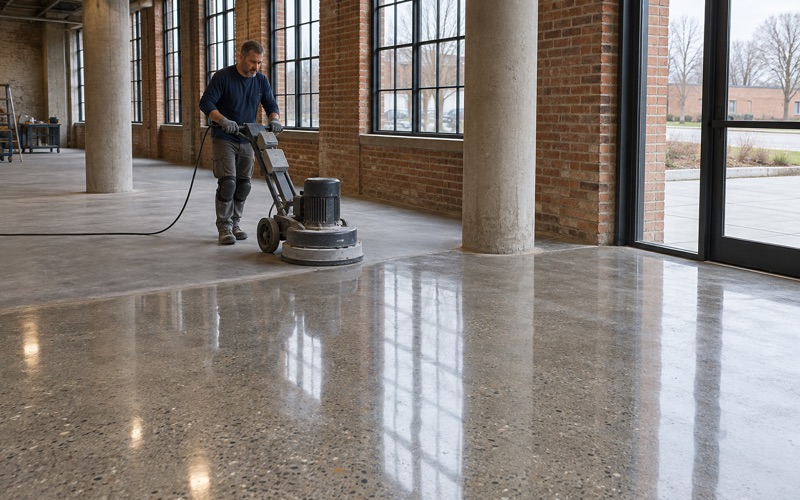
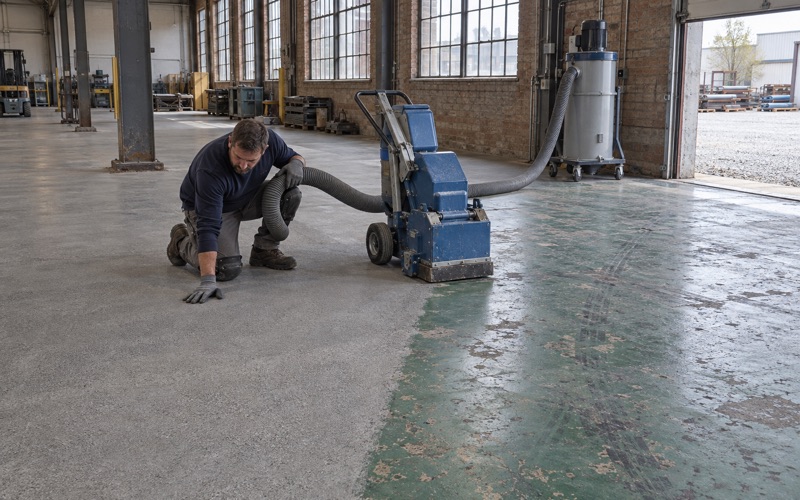
Every slab we coat is opened with a diamond grinder or shot blaster first, never acid etched, and moisture testing is written into the scope as its own line. Before we price anything, we read the cracks, joints and old coating. If a slab needs repair or replacement before it can hold a coating, we tell you that up front instead of coating over the problem.
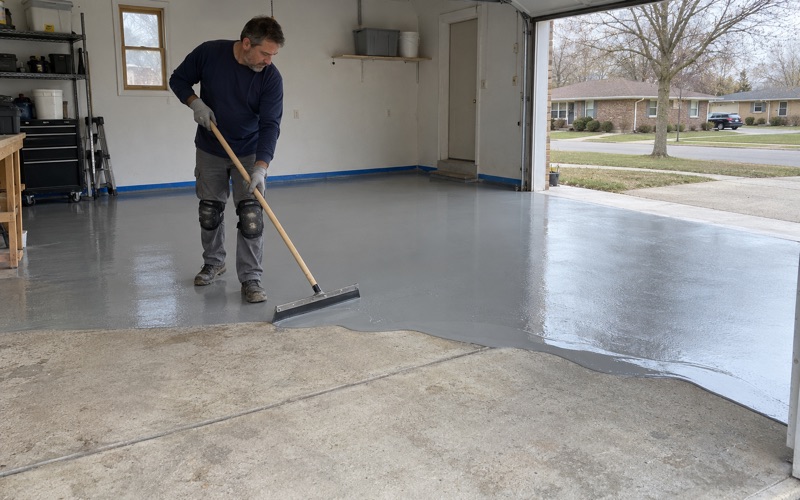
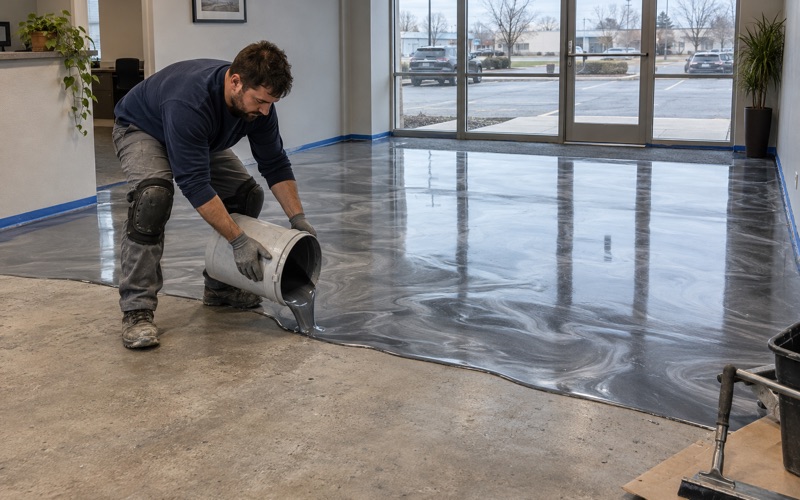
What we install near abrasive work is deliberately plain: a smooth, abrasion-resistant epoxy or urethane cement system in a color that contrasts with gray steel shot, with walkways marked in a second color. It is not a coarse, heavily textured finish, because texture is exactly where a stray pellet hides. The rest of this page explains why that choice matters.
Shot-Blast Machines and the Floor Outside the Enclosure
Blast Cleaning Technologies on W. Greenfield Avenue
West Allis is a Milwaukee County city of 60,325 residents at the 2020 census, and it still builds blast-cleaning machinery. Blast Cleaning Technologies manufactures shot blast equipment components, parts and systems for foundries and forge facilities. It works out of a 150,000 square foot headquarters in the historic Allis-Chalmers manufacturing complex at 6682 W. Greenfield Avenue.
We mention it as a landmark, not as a customer, and because it puts abrasive blasting at the center of this page. Any West Allis shop that runs a blast cabinet or blast room of its own, whether it finishes castings, preps steel or rebuilds equipment, carries a specific housekeeping duty on the floor around that machine.
What 29 CFR 1910.94 Asks of the Floor
OSHA’s abrasive-blasting standard, 29 CFR 1910.94(a)(7), is short and direct. Dust shall not be permitted to accumulate on the floor or on ledges outside of an abrasive-blasting enclosure, and dust spills shall be cleaned up promptly. Aisles and walkways shall be kept clear of steel shot or similar abrasive which may create a slipping hazard.
Notice what the rule does not say. It names clear walkways and a floor without dust, not a coating, and no coating carries an OSHA approval. Wisconsin private employers answer to federal OSHA, so the obligation stays with the shop’s housekeeping. What a floor can do is make that housekeeping faster, more visible and easier to verify at the end of a shift.
Inside the Enclosure Stays Bare
The same standard, at 1910.94(a)(1)(iv), defines a blast-cleaning room as a complete enclosure in which blasting is performed. We do not apply coatings inside a blast-cleaning room or cabinet, and we do not promise any finish that stands up to a direct blast stream. Our work starts at the enclosure door, where shot escapes on boots, parts and carts.
Looking for epoxy-flooring closer to Burlington? See Burlington Epoxy-Flooring.
Steel Shot Underfoot: Seeing It and Clearing It
Why a Smooth Finish Beats a Coarse One Here
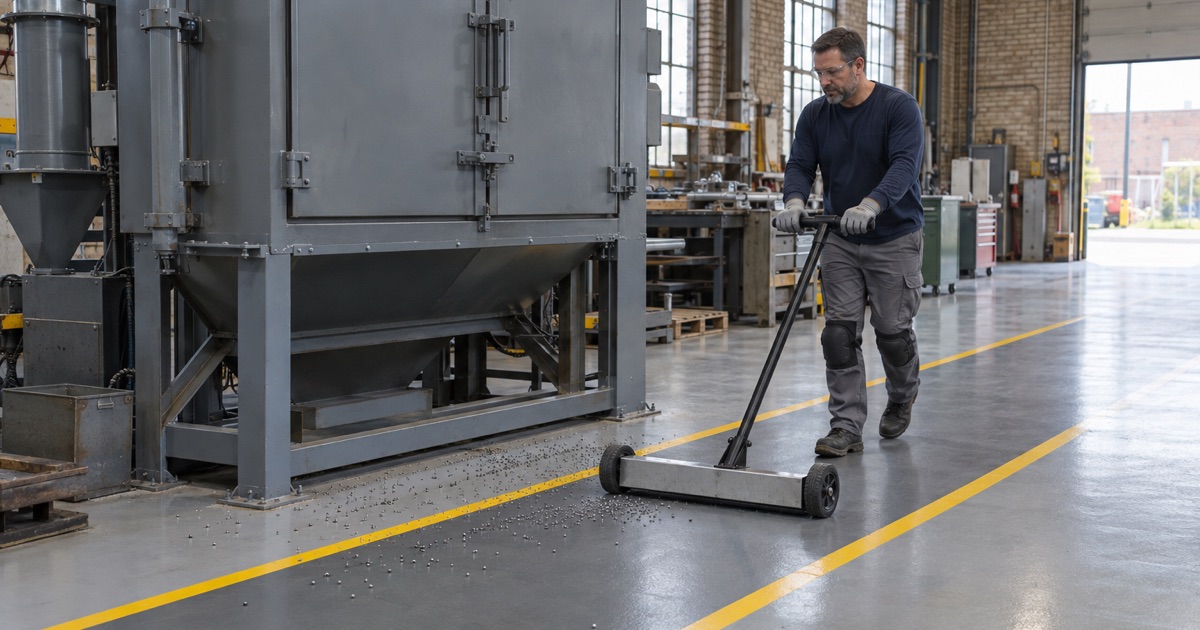
Steel shot behaves like ball bearings on a hard floor, and steel abrasive safety data sheets warn that shot on horizontal surfaces can create slip and fall hazards. On a heavy quartz or deep flake broadcast, pellets settle into the valleys of the texture. They stop being visible, a broom rides over them, and they stay underfoot until someone steps on the wrong spot.
So beside abrasive equipment we lean toward a smooth or lightly textured 100% solids epoxy or urethane cement body coat, adding fine aggregate only where a wet process demands grip. The surface still needs slip resistance. It should come from a controlled, shallow profile that a broom can reach into, not from a rough broadcast that holds everything that lands on it.
Contrast That Makes a Stray Pellet Show
Steel shot and grit run dark gray to near black, and a dark gray floor hides them almost perfectly. A light color, such as safety yellow, tan or a pale gray far enough from the abrasive, turns every escaped pellet into a visible dot. A supervisor walking the aisle can tell at a glance whether the walkway is clear.
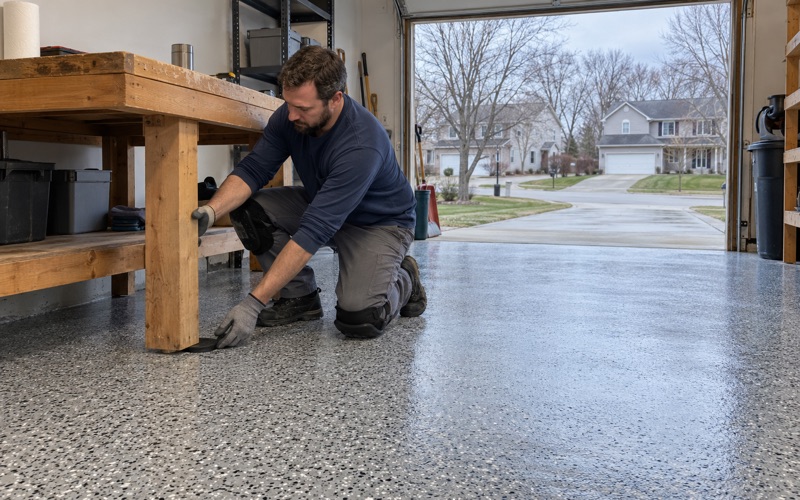
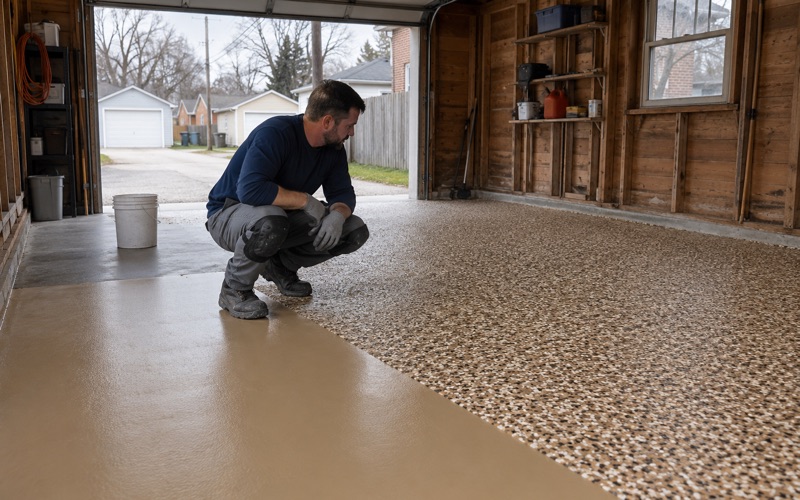
We usually avoid busy flake blends next to the blast area for the same reason. A speckled vinyl flake broadcast reads well in a showroom or garage, but its pattern camouflages small round objects. A solid color with contrasting striping gives the eye nothing to confuse with a pellet, and where an owner wants flake, we keep it to offices and break rooms.
Magnet and Broom Pickup
A smooth, sealed surface is what lets a sweep magnet or a push broom clear shot completely in one pass. Open pores, pinholes from outgassing and rough patch work all trap pellets, which is one reason we prime porous concrete carefully and watch for outgassing on warm afternoons. A floor that releases everything on the first sweep supports the prompt cleanup the rule asks for.
We check the finished floor the way your crew will use it. After the topcoat cures, a sweep magnet and broom pass over a sample area should leave nothing behind, and if a spot holds shot, we correct it before we leave. That check takes minutes and tells an owner more than any brochure could.
Abrasion, Marked Walkways and Joints
Shot Ground Under Wheels and Boots
Shot that escapes the enclosure does not just sit there. Cart wheels, pallet jacks and boots grind it into the surface, and that steady abrasion dulls and scratches a soft finish quickly. We build these floors to a stated thickness with an abrasion-resistant topcoat, often a polyaspartic or urethane, and the proposal names the product and system so you can check what went down.
Urethane cement is a strong choice where the area also sees hot parts, washdown or thermal swings, because it tolerates conditions that stress a thin epoxy. Where the floor stays dry and abrasion is the main load, a thick epoxy body coat under a hard topcoat usually does the job. We explain which one we recommend and why, before anything is ordered.
Walkways Marked in a Second Color
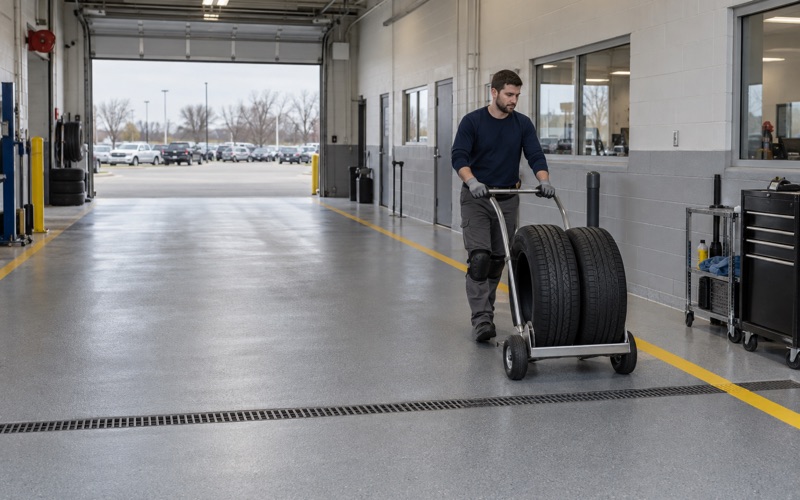
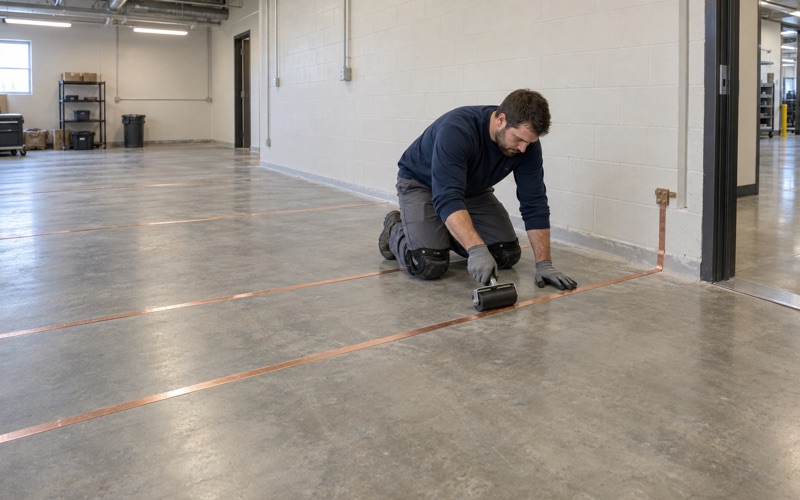
The standard speaks to aisles and walkways, so we make them obvious. Coated striping in a contrasting color marks the pedestrian route past the blast equipment, the forklift lanes and the zone at the enclosure door where shot is most likely to land. When the route is marked, it is easier to sweep on a schedule and easier to see when it is not clear.
Striping goes down as part of the same coating system rather than as hardware store paint on top, so it wears at the rate of the floor around it. We also keep the topcoat over the lines smooth and level, because a raised paint line is one more edge for shot to collect against.
Joints, Cracks and Edges
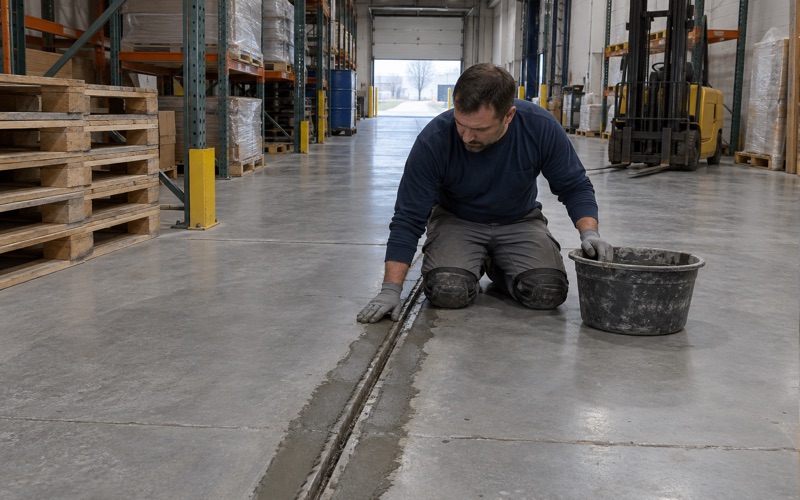
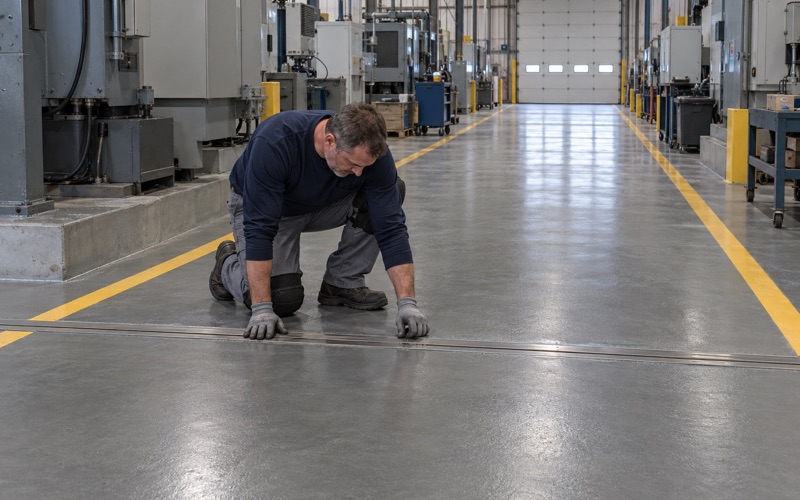
Saw cuts and construction joints are natural traps for steel shot and the places where forklift wheels break a coating edge first. We fill plant and shop joints with a semirigid filler before any coating goes over them, and we repair spalled cracks rather than bridging them. A joint that sits flush with the floor gives a pellet nowhere to lodge.
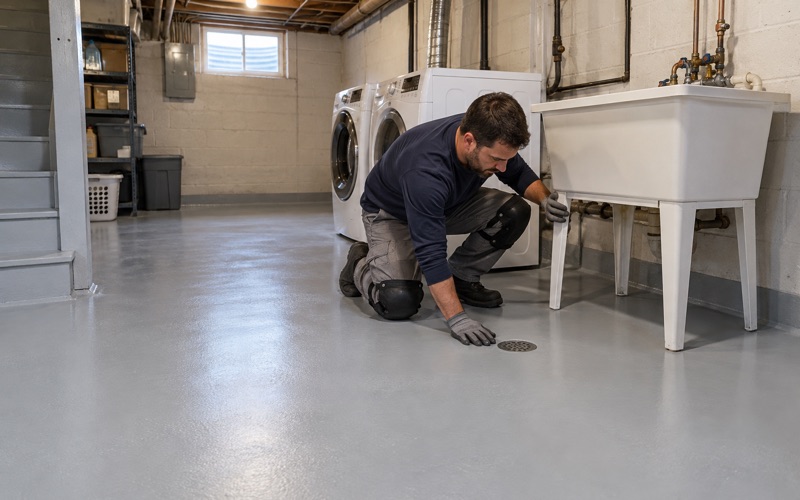
Edges at the enclosure threshold, floor drains and column bases get the same attention. We terminate the coating in a saw-cut keyway rather than feathering it out, so a cart wheel or a sweep magnet catches nothing and the edge does not lift where shot collects.
Planning Shop-Floor Work in West Allis
Permits and the Plan Review Application
Commercial work that alters a building in West Allis needs a Plan Review Application through Building Inspection and Neighborhood Services, and the city’s permit page cites the Wisconsin Commercial Building Code. The 2026 fee resolution prices commercial alterations at $0.40 per square foot or $18 per $1,000 of construction value, at the code enforcement director’s discretion, with a $150 minimum.
Coating an existing slab and replacing a slab are different questions, so we ask the city before we schedule rather than assuming either way. If a damaged section near the blast area has to be cut out and repoured, that work and any review it needs go on the calendar first.
Moisture, Temperature and Production Hours
A dry-looking slab is not proof of a dry one, so we run ASTM F2170 in-situ relative humidity probes or ASTM F1869 calcium chloride tests before we commit to a system. Where the readings run high, a moisture-mitigation primer goes into the scope from the start. We also read the dew point spread at the slab surface and schedule curing against slab temperature, not the calendar.
A shop running a blast line rarely wants it down for a week. We work around the hours the building has to keep running, including overnight and weekend windows, and we sequence the floor in sections so the enclosure door area can be done during a planned maintenance stop. Grinding dust and slurry are collected on site and never washed toward a storm drain.
What Your Proposal Will Show
Every proposal names the product, the system build and the finished thickness, along with the ICRI CSP surface profile we will reach for that coating. Warranty exclusions are read to you before the job is sold, with moisture named first. If a slab needs repair before it can be coated, that is in writing too.
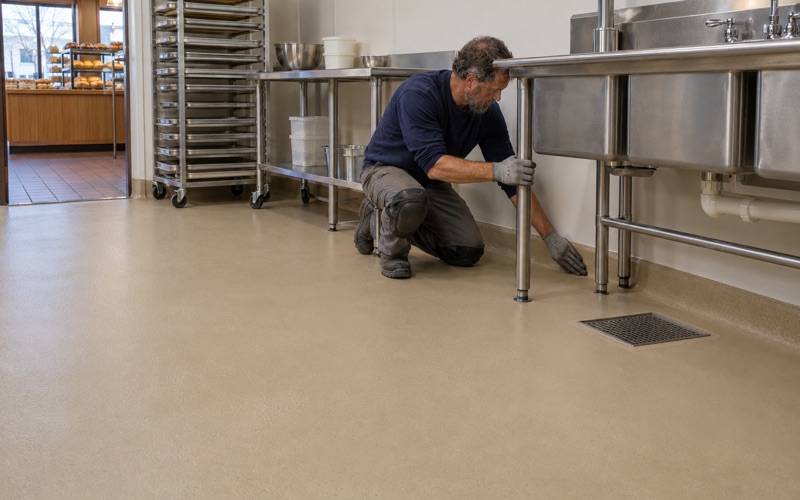
For a food business elsewhere in the city, inspections fall to the Southwest Suburban Health Department, shared with Greenfield since 2024, and we plan a smooth, easily cleaned finish with that in mind. Next to a blast machine, though, the test stays the one this page started with: can the shift see the shot, and can it clear the walkway completely?
- 20+ Years on Concrete
- Moisture Tested First
- Written Contracts