Racine Epoxy Flooring has spent more than 20 years on epoxy flooring in Sturtevant and across the county, and the floors we think hardest about here are the ones where a fine powder settles every shift. In a dry-blend food plant, a coating is judged less by how it looks on day one than by how easily a crew can see and remove what lands on it.
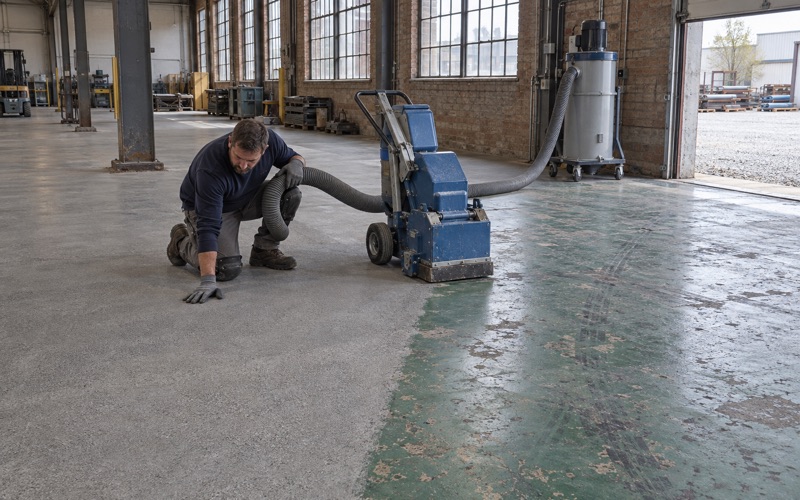
That changes the questions we ask before quoting. We want to know what color the product is, how it settles, how the crew cleans, and which joints and cracks already trap it. We open every slab with a diamond grinder or shot blaster rather than acid, and the proposal names the product, the system build and the finished thickness so a plant engineer can check it later.
Garages, basements and shops in the village get the same mechanical prep and the same moisture testing written into the scope. This page follows a narrower thread: how a resin floor supports powder housekeeping in a seasoning plant, where OSHA’s dust guidance starts, and where a floor coating’s job ends.
A Seasonings Plant on Enterprise Drive
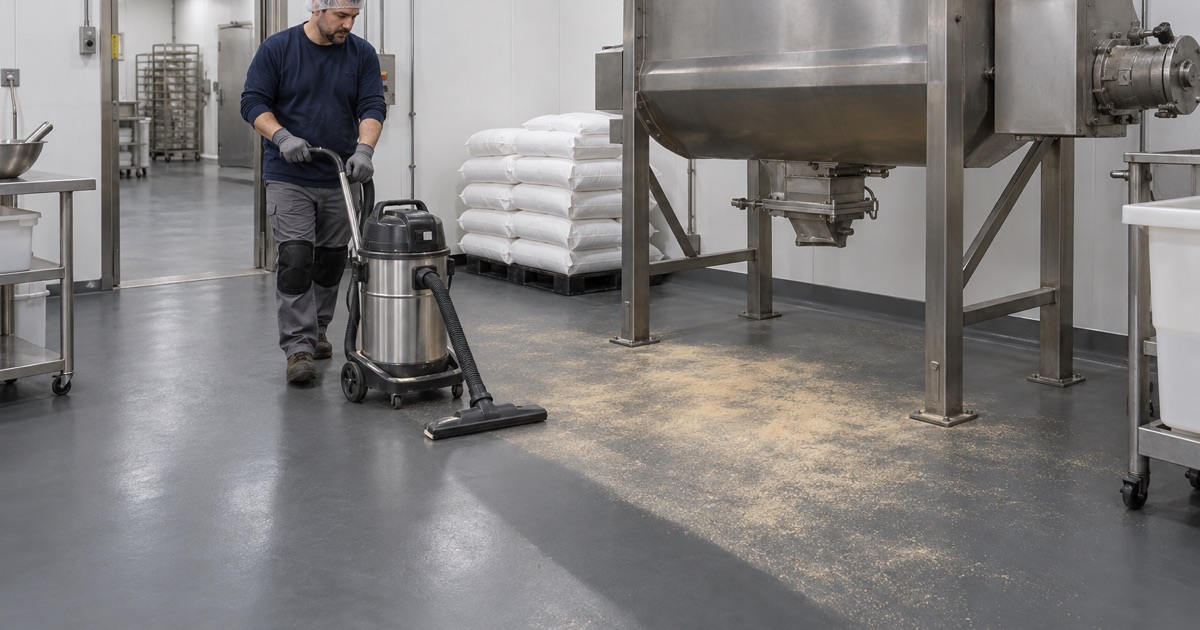
Sturtevant’s business park holds more food processing than a passerby would guess, and the clearest example of what that means for a floor sits on Enterprise Drive. A seasoning plant and a commercial bakery put a floor to work in ways no garage ever does.
The Plant at 1751 Enterprise Drive
Kerry’s seasonings plant sits at 1751 Enterprise Drive, inside the Village of Sturtevant in Racine County. On the state’s food processing plant license list dated October 7, 2026, Kerry Inc. holds two DATCP licenses at that address, numbers 121789 and 522347, one in the large potentially hazardous class and one in the large non-potentially hazardous class.
In 2014 the plant added 76,320 square feet with 10 loading docks and dedicated spice storage, and the interior renovation brought new blending cells and relocated quality-assurance space. We have not been inside that plant and have not read its floors or its records. We point to it because it shows what kind of work a seasoning operation in this village actually runs.
Why Blending Rooms Behave Differently
A blending cell moves dry organic powders: ground spices, dried herbs, salt carriers and starches. Fine particles drift off a mixer, a bag dump or a tote change and settle on every horizontal surface, the floor included. Organic powder this fine is combustible dust, which is why the floor in a blending room belongs to the housekeeping program rather than being just something people walk on.
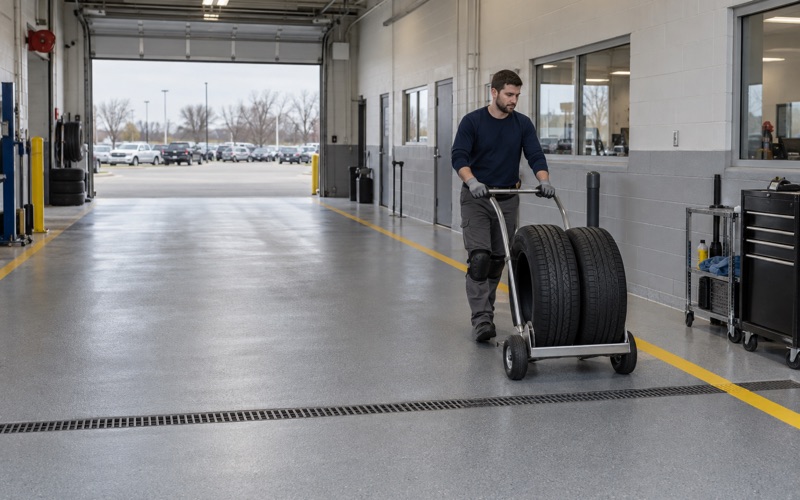
That makes the coating question unusual. In a garage the floor fights salt brine and hot tires. In a blending room its main job is to make a thin settled layer obvious and easy to remove, and to leave no gaps where powder can build up out of sight between cleanings.
Other Licensed Food Plants in the Village
Enterprise Drive is not the only licensed food address. Wisconsin Brother’s Bakery, doing business as Lehmann’s Bakery, holds a DATCP food processing license at 9117 Durand Avenue, where more than 36 kringle flavors are made daily and shipped nationally. Flour and sugar are powders too, and a bakery production floor faces many of the same cleanup questions as a spice room.
Licensed plants in Wisconsin also answer to the ATCP 70 food processing rules. When we plan a floor in one, the finish schedule is built to be wiped, vacuumed and washed the way that plant actually cleans, and we ask about allergen changeovers before choosing a color or texture.
Looking for epoxy-flooring closer to Caledonia? See Caledonia Epoxy-Flooring.
Why OSHA Measures Combustible Dust on the Floor
Federal OSHA covers private employers in Wisconsin, and its approach to combustible dust gives the floor a surprisingly central role. Inspectors look up at beams and ductwork, but one of the screening yardsticks they reference is read straight off the floor.
1/32 Inch Over Five Percent of the Floor Area
In a standard interpretation dated April 21, 2015, OSHA addressed how deep an accumulation of combustible dust has to be before it is treated as hazardous. The letter describes a layer about 1/32 inch deep spread over five percent of the floor area of a room or a building, or over 1,000 square feet, whichever is less.
That is close to the thickness of a credit card, and a layer that thin is hard to see on the wrong floor. The same figure is referenced in CPL 03-00-008, the reissued Combustible Dust National Emphasis Program, which steers inspection attention toward facilities that handle combustible dust.
A Screening Depth, Not a Universal Rule
The 1/32-inch figure rests on assumptions, including a bulk density of 75 pounds per cubic foot. A lighter or heavier powder changes the math, so the number works as a screening depth for deciding when a layer deserves attention, not as a fixed threshold applied the same way to every material a plant handles.
We bring it up for a practical reason. If a plant’s housekeeping depends on catching a layer that thin across part of a room, the floor under it has to cooperate. A dark, busy or heavily textured surface hides exactly the kind of film the measurement is about.
Where the Five Percent Adds Up
Five percent sounds small until it is translated to a real room. In a 20,000-square-foot blending area, five percent is 1,000 square feet, so both limbs of the test land in the same place; in a larger room, the 1,000-square-foot limb governs. Powder along walls, under conveyors and around equipment bases adds up faster than an open aisle suggests.
That is why we look hard at the edges of a floor: the cove at the wall, the base plates of mixers, the strips under conveyors. Those are the places a mop skips and powder collects.
Color, Sheen and Closed Joints for Powder Housekeeping
Once the goal is visibility and easy removal, the coating choices follow from it. None of them is exotic; they are ordinary system decisions made with a powder in mind.
Picking a Color That Shows the Product
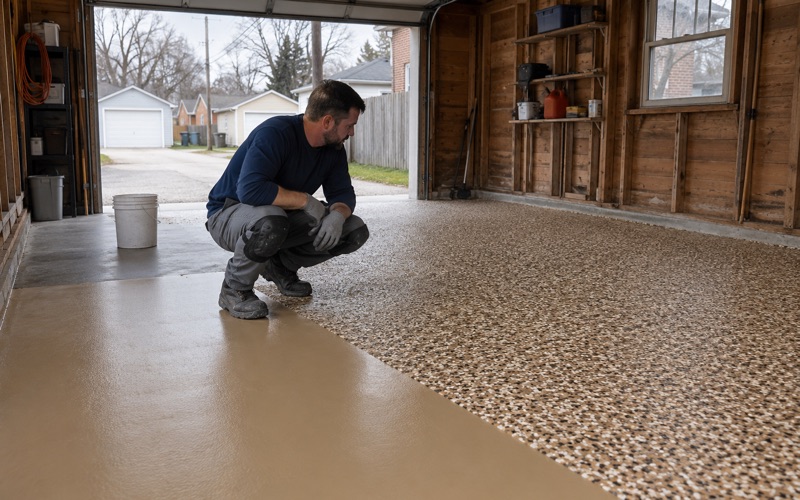
A floor color should contrast with what the plant makes. Pale seasonings such as garlic, onion or salt blends disappear on a light gray or beige floor and stand out on a medium or darker gray. Paprika, chili and turmeric blends read the other way. We ask what runs most often, and we avoid a heavy vinyl flake broadcast that camouflages a settled film.
Some plants zone the color, with one shade in blending cells and another in packaging or warehouse aisles. That helps a supervisor walking through spot a layer from the doorway instead of on hands and knees.
Sheen and Texture That Give Powder Up
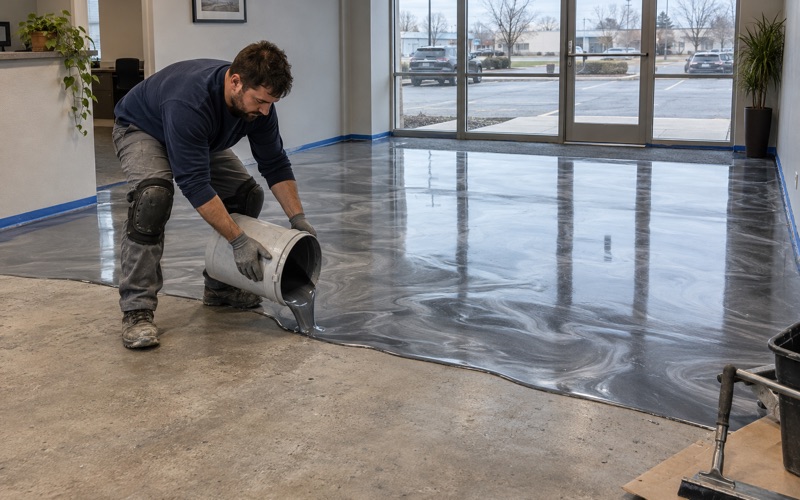
A smoother, higher-sheen topcoat lets a vacuum lift fine powder in one pass, while a deep aggregate texture holds it in the valleys. Where traction is needed, we keep any quartz aggregate broadcast light and lock it down with a topcoat so the profile stays shallow. Polyaspartic and urethane cement systems are options we compare against the plant’s washdown and temperatures.
We also watch for amine blush, outgassing and pinholes during the install. A pinhole field in a topcoat is a thousand tiny pockets for powder, so a clean, closed finish is a housekeeping detail, not just a cosmetic one.
Closing Joints and Cracks Before the Coating Goes Down
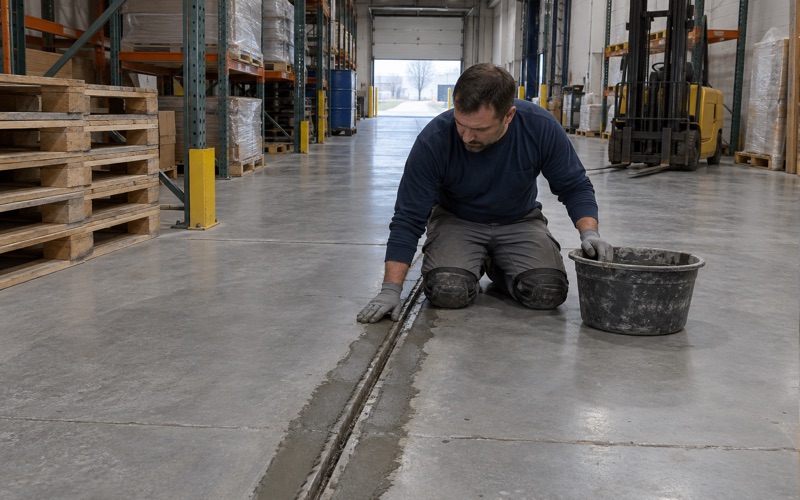
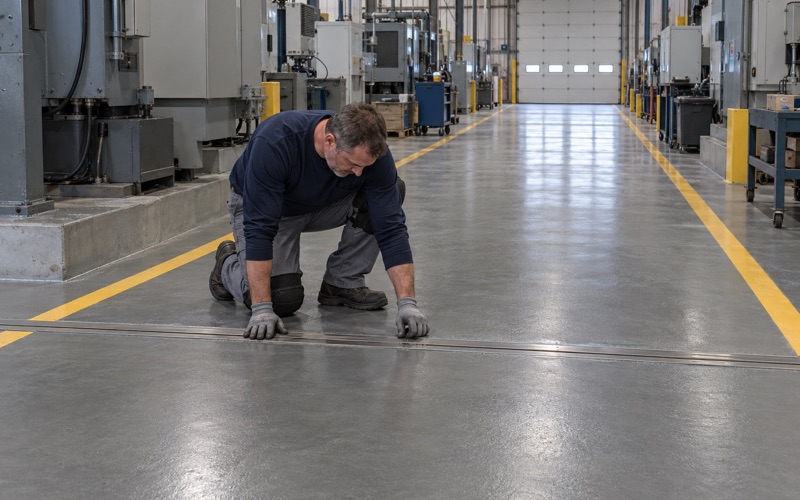
An open saw cut or a spalled crack is a trough that fills with powder and empties only with a crevice tool. We fill plant joints with a semirigid filler before coating so cart and forklift wheels do not break the edges, and we route and fill cracks rather than simply bridging them with resin.
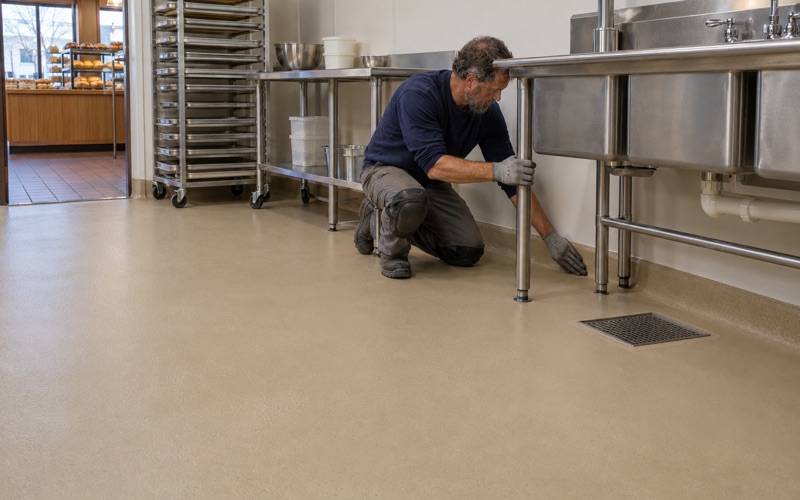
Where the slab meets the wall, an integral cove removes the corner where dust packs in. We read existing cracks, joints and old coating before we quote, and if a section is too far gone to coat, we say so in the proposal instead of hoping a topcoat hides it.
What a Coating Does Not Do, and How We Plan the Work
The last part of any plant conversation is about limits and logistics. Both matter as much as the resin, because a floor that is oversold or badly timed causes more trouble than a plain one done right.
The Dust Hazard Analysis Stays With the Plant
A floor coating is a housekeeping aid. It does not control combustible dust, it does not change how much a mixer releases, and it does not make a plant compliant with OSHA’s emphasis program or any NFPA standard. The dust hazard analysis, cleaning frequency, dust collection and ignition controls all belong to the plant and its safety advisers.
We say that up front because a floor sold as a safety system invites a plant to clean less. What we can promise is narrower: a surface built so the cleaning the plant already does is easier to see and faster to finish.
Prep, Moisture and Production Windows
Food plants rarely stop for long, so we plan grinding, coating and curing around shifts, including overnight and weekend windows. Grinding runs with dust collection, and slurry is gathered on site rather than washed toward a drain. The grinder or shot blaster leaves a profile matched to the system’s ICRI CSP range, so a 100% solids epoxy base gets the anchor it needs. Moisture testing is a line item, using ASTM F2170 relative humidity probes or ASTM F1869 calcium chloride tests depending on the slab.
Curing follows slab temperature and the dew point spread at the surface, not a calendar date, and warranty exclusions are read out before the job is sold, with moisture first on the list.
Permits and Paperwork in the Village
Since January 2021, SAFEbuilt has provided building inspection services for the Village of Sturtevant, with permits handled through the village website or the office at 2801 89th Street. Coating an existing slab and replacing one are different questions, so we ask the village inspector before scheduling. Homeowners here get a written contract before any deposit, as Wisconsin’s ATCP 110 requires.
Most plant coatings involve no structural change, but a job that cuts out and replaces slab sections is a different scope. On the residential side, the Wisconsin Uniform Dwelling Code does not require a vapor retarder under an unconditioned attached garage slab, which is one more reason we test a garage floor before coating it rather than trusting how dry it looks.
- 20+ Years on Concrete
- Moisture Tested First
- Written Contracts