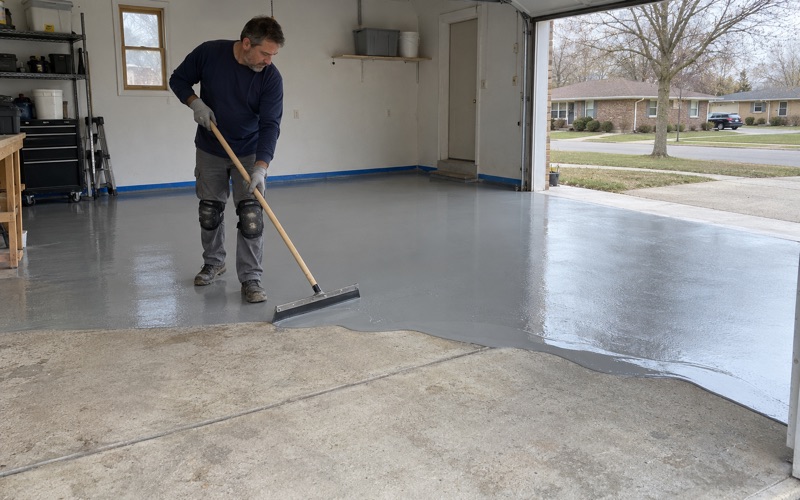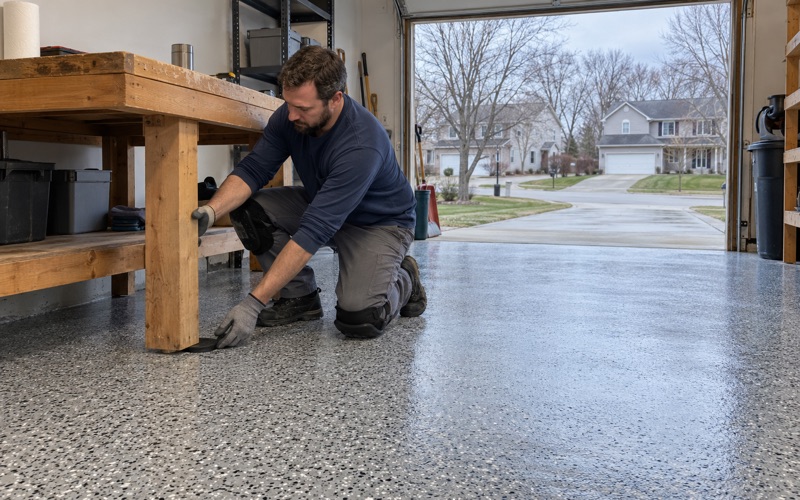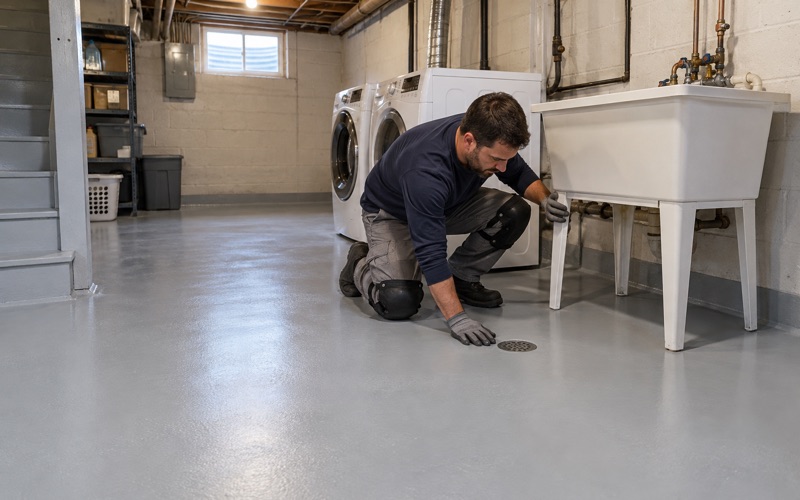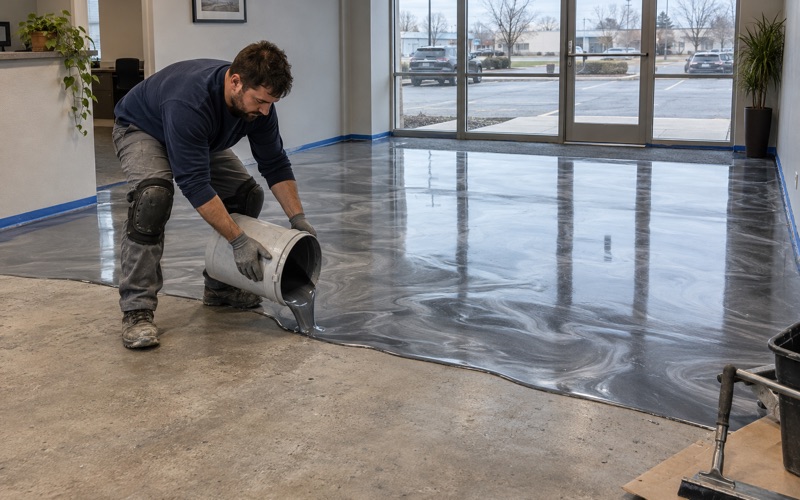
Racine Epoxy Flooring has spent more than 20 years on epoxy flooring in Somers and across our service area, and the floors we are asked about most here belong to buildings that run forklifts all shift. A forklift fleet brings a battery room with it, and that room is where a warehouse floor stops being dry.
Most of a distribution floor sees tires, pallets and the occasional dropped carton. The charging bay sees electrolyte, the water used to flush it and the neutralizer that follows. We treat that zone as its own job, with its own coating build, edges and drainage plan, instead of carrying the aisle specification into it and hoping it holds.
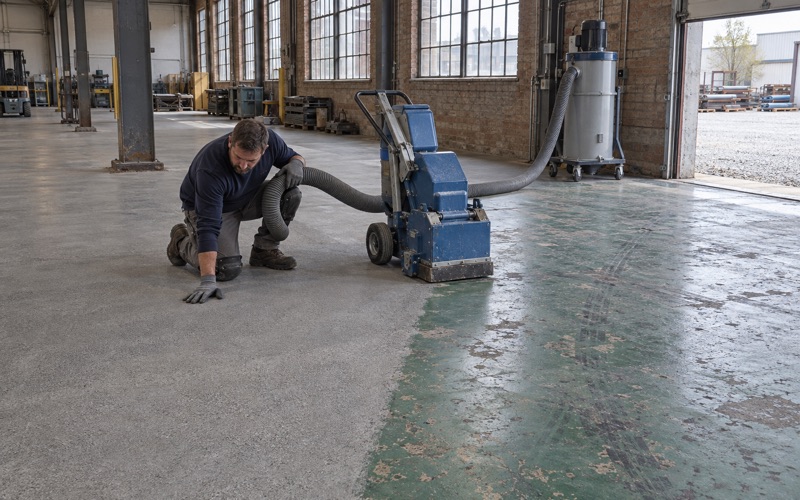
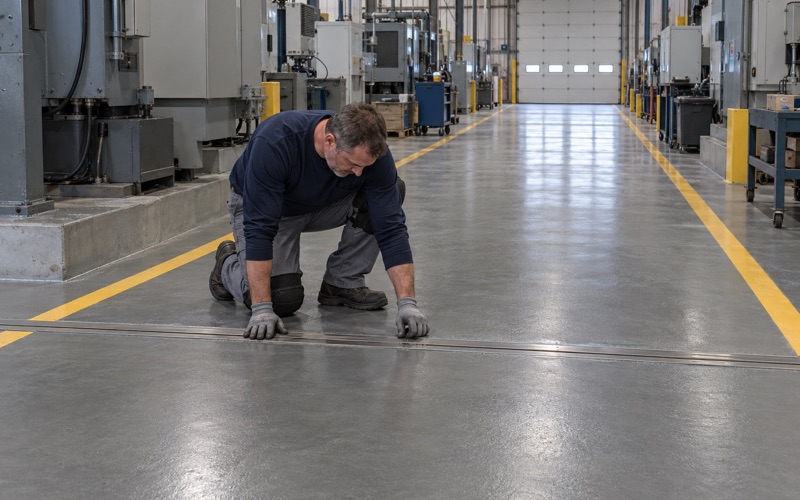
Before we price either zone, we open the slab mechanically with a diamond grinder or shot blaster, never an acid etch, and we read the joints, cracks and any old coating first. Our proposal then names the product, the system build and the finished thickness for each area, so a facility manager can check what was installed against what was quoted.
Forklift Warehouses and the Battery Room in First Park 94
Distribution space along the I-94 frontage
First Park 94 sits near 88th Avenue and 38th Street on the east side of I-94, one of five warehouse and industrial projects that together put about five million square feet under construction or newly completed in the village. Ariens began operations there on December 16, 2016, in the park’s first 600,000-square-foot building, consolidating warehousing from the Fox Valley, Matteson, Illinois and Jasper, Indiana.
Somers itself is a young municipality. The village was incorporated on April 24, 2015, from part of the Town of Somers, and it now holds nearly all of the former town across 25.27 square miles of Kenosha County. One building department, at 7511 12th Street, serves both the village and the remaining town.
Crown Brands on 31st Street
In February 2019 the Village of Somers announced that Crown Brands LLC, a Lincolnshire, Illinois restaurant supply company, was moving its Savannah, Georgia warehouse into a building of about 300,000 square feet at 8725 31st Street in First Park 94. The first hires the village listed were forklift operators, alongside inventory control, pickers and shipping staff.
We mention it because of what that hiring list implies, not because we have been inside. We have not seen the battery type or charging setup in that building, or in any other in the park. What the list tells a flooring contractor is that a fleet of powered industrial trucks needs somewhere to charge, and that somewhere has rules.
Why the charging area is a separate floor
A warehouse floor is planned around wheel loads, abrasion and joint edges. A charging area adds a liquid that is corrosive when it spills and water that is applied on purpose to deal with it. Those two demands do not call for the same coating, the same edge detail or the same slope, so we quote them as two areas.
In practice that means two sets of questions on the site walk. For the aisles we ask about wheel types, load weights and which joints are already chipping. For the charging area we ask where batteries are watered, where the neutralizer is stored and where flush water is supposed to go once it leaves the floor.
Looking for epoxy-flooring closer to Kenosha? See Epoxy-Flooring Services in Kenosha.
OSHA’s Battery-Charging Rule and a Floor That Gets Washed
What 29 CFR 1910.178(g) asks for
OSHA’s powered industrial truck standard covers battery charging in 29 CFR 1910.178(g). Paragraph (g)(1) says battery charging installations shall be located in areas designated for that purpose. Paragraph (g)(2) requires facilities for flushing and neutralizing spilled electrolyte, for fire protection, for protecting charging apparatus from damage by trucks, and for adequate ventilation for dispersal of fumes from gassing batteries.
Further down, (g)(4) calls for a conveyor, overhead hoist or equivalent for handling batteries, and (g)(6) for a carboy tilter or siphon when electrolyte is handled. Paragraph (g)(7) states the old rule plainly: acid is poured into water, never water into acid. Mixing happens in the room, so spills happen there too.
What the rule does not say about coatings
None of those paragraphs names a floor coating. OSHA asks for the facilities; it does not approve a product, and a coated floor alone does not make a battery room compliant. We say that before the proposal, because a buyer who thinks the floor is the compliance item may skip the neutralizer supply or the ventilation that actually are.
What the floor can do is make the required facilities work. A sound, sealed surface lets spilled electrolyte be contained, neutralized and flushed without soaking into bare concrete, and it lets the crew see that the area has been cleaned rather than guessing. Bare concrete takes acid into its paste, and repeated exposure leaves a rough, weakened surface that holds residue and is harder to rinse clean each time.
Flushing and neutralizing on a coated surface
The cleanup sequence drives the coating choice. Electrolyte lands on the floor, a neutralizer goes down on top of it, and water follows to carry the residue to wherever the facility collects it. The coating sees acid, then an alkaline neutralizer, then standing water, often in the same hour and repeated over years of shifts.
We select a system for that cycle from published resistance data for those specific exposures, rather than leaning on a general promise about chemical resistance. That usually means a 100% solids epoxy build with a topcoat chosen for the chemistry, and a finished thickness written into the proposal so it can be measured later.
Curbs, Slope and Charger Protection in the Bay
Keeping the flush inside the bay
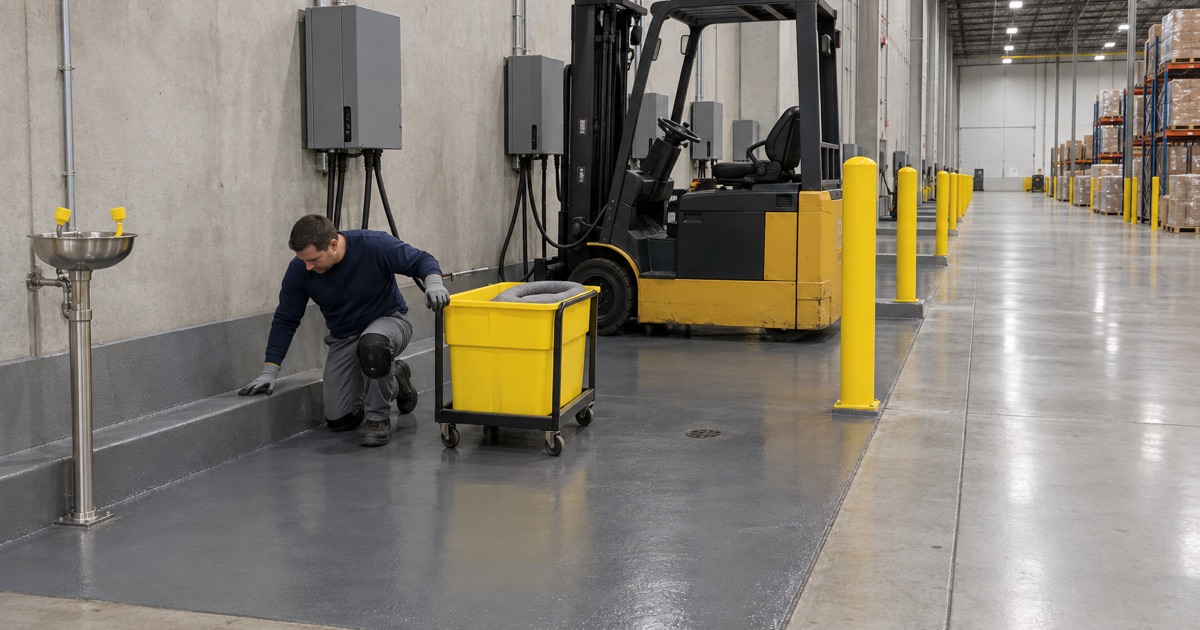
Flush water that runs out into the aisles carries whatever it picked up along with it. So the charging bay needs a boundary: a curb along its open edges, a floor sloped toward a collection point, or both. Which one fits depends on the existing slab and where the facility wants the water to end up, so we survey before we specify.
A curb that holds liquid has to bond to the slab and carry the coating up and over it, so we build the floor and curb as one continuous system rather than two pieces meeting at a seam. Grinding dust and slurry from our own prep are collected on site and never washed toward a drain.
Bollards and chargers
The (g)(2) language about protecting charging apparatus from trucks usually means bollards or guard rails in front of the chargers. Each anchor drilled through a coated floor is a hole in the barrier, so we prefer to know the bollard layout before the coating goes down and detail the penetrations, instead of patching around posts set later.
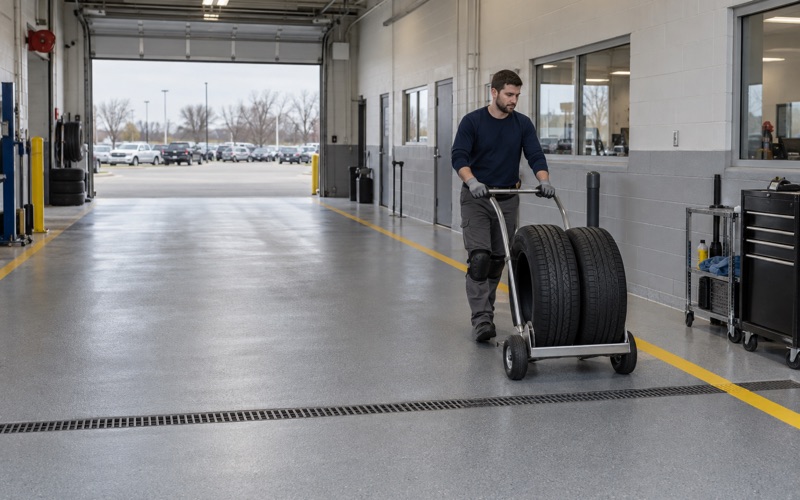
Truck traffic also concentrates at the bay entrance, where loaded forklifts turn and stop. That edge takes more abrasion than the bay interior, and it is where the transition between the charging zone and the aisle needs to be ground in flush rather than left as a lip for a wheel to catch.
Joints, cracks and moisture inside the zone
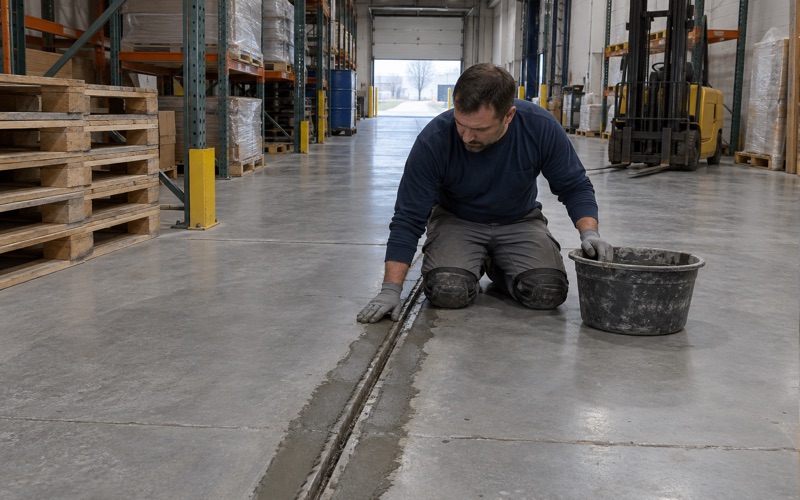
A control joint running through a charging bay is a path for electrolyte into the slab. We read the joints and cracks before quoting, fill what can be filled with a semirigid filler, and say plainly when a section of slab needs repair before it is worth coating at all.
Moisture testing is part of the same scope. A slab pushing vapor up from below will lift a coating no matter how good the chemistry on top is, so we run ASTM F2170 relative humidity probes or calcium chloride tests before committing to a system, and the warranty exclusions, moisture first, are read out before the job is sold.
Aisles, Charging Zones and Changing Battery Chemistry
Two specifications on one slab
In the aisles, the job is abrasion, wheel loads and joint edges that do not spall. In the charging zone, the job is containment and repeated cleanup. We write the two areas as separate line items with their own products and thicknesses, so a facility can see where the money goes and why the bay costs more per square foot.
The aisle system can then be chosen for what aisles need, typically an epoxy build with a wear-resistant topcoat and quartz aggregate broadcast where traction matters, without paying for chemical-exposure detailing across thousands of square feet that will never see a drop of electrolyte.
Splitting the specification also helps scheduling. A warehouse that has to keep shipping can often take the aisles in sections during overnight or weekend windows, while the charging bay is done during a planned outage when the trucks charge somewhere else.
Lead-acid, lithium and what changes on the floor
Everything in (g)(2) about spilled electrolyte assumes batteries that can spill it, which in practice means flooded lead-acid units that are watered on a schedule. Lithium-ion forklift batteries are sealed and are not watered in the room, which changes the electrolyte question considerably. A fleet that has converted, or plans to, may not need the same containment detail.
Mixed fleets are common during a changeover, and a room that charges both chemistries still has to be built for the one that can spill. We ask what the fleet runs now and what it is expected to run in five years before deciding how much of the bay gets the heavier build.
Scheduling the cure
Curing is scheduled against slab temperature and the dew point at the surface rather than the calendar. A slab inside a heated building is usually workable year-round, but a charging bay near a dock door in January may not be, and we would rather move the date than coat a slab too cold to cure.
First Park 94 lies east of I-94, inside the part of Kenosha County designated nonattainment for the 2015 ozone standard. Wisconsin has no state architectural-coating VOC rule, so we work to the national rule in 40 CFR 59 Subpart D and keep the product data sheets with the job file for the facility’s records.
- 20+ Years on Concrete
- Moisture Tested First
- Written Contracts