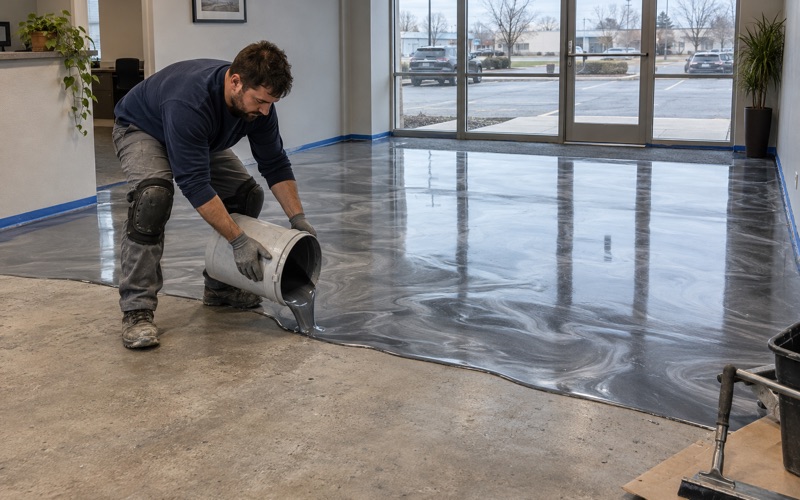
Racine Epoxy Flooring has spent more than 20 years installing epoxy flooring for shops, food spaces, basements and garages, and in Hales Corners many of our commercial calls arrive with a move-in date already attached. A tenant has signed a lease, the previous occupant is gone, and the floor has to be ground, coated and cured before anyone sets equipment on it. That calendar, more than the coating chemistry, usually decides how the job is built.
We plan those jobs backward from the day the space has to be ready. That means knowing which system can cure in the time available, which tasks belong to a plumber or electrician rather than to us, and which paperwork the new occupant owns. Getting that order right is the difference between a floor finished on time and one that holds up an opening.
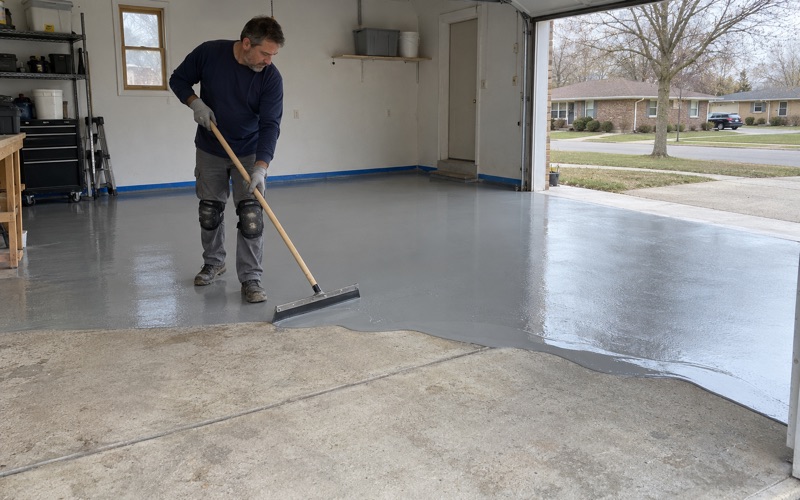
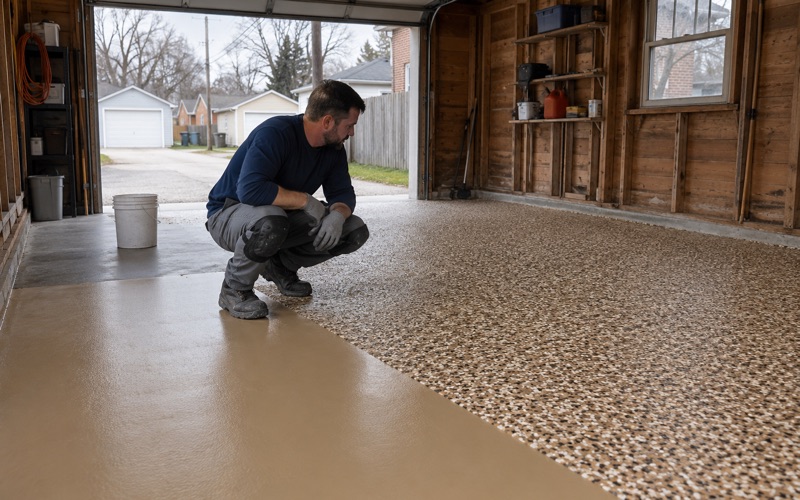
Homeowners get the same planning in a different form. A garage or basement floor is scoped after we test the slab, read its cracks and joints, and look at whatever coating is already on it, and the written proposal names the product, the system build and the finished thickness. Nothing is applied until the concrete has been opened mechanically.
Moving Into Hales Corners: The Occupancy Permit and Its Sign-Offs
The Village of Hales Corners requires an occupancy permit for every new occupant of a space, commercial or residential, and the application belongs to the business or household moving in. The village form, revised in February 2024, lists a $205 fee for commercial occupancy, $50 for residential and $80 for a temporary occupancy of six months or less. It is handled through Village Hall at 5635 S. New Berlin Rd.
Fourteen Days Before Move-In
The form is blunt about timing: it must be submitted 14 days before occupying the space, counted back from the requested occupancy date. For a tenant, that starts a two-week clock at the same moment we would like to start grinding, and both tasks compete for the same empty room. We ask new occupants to file first and tell us the date they wrote on the application.
That date becomes the end point of our schedule rather than a hopeful target. Grinding, any crack and joint repair, primer, body coats and topcoat all have to fit ahead of it with room left over for cure. If the window is too tight for the system the space needs, we say so before a deposit is taken, not on the morning of the walk-through.
Building, Electrical, Fire and Health Inspectors
The certificate carries sign-off lines for four inspectors: building and plumbing, electrical, fire, and the Hales Corners Health Department. Each one walks the space for its own part of the occupancy, and none of them is there to grade a floor coating. What we control is whether the floor is finished, cured and clear of our equipment when they arrive.
A room still taped off, smelling of resin, or blocked by a grinder and dust extractor is a room the inspectors have to work around. We pull our gear, collect the grinding dust and slurry, and leave the space clean so the walk-through is about the occupancy and nothing else. Questions about the permit itself go to Building Inspection at 414-423-2100, extension 3107.
What the Permit Is Not
The occupancy permit is the occupant’s application, not the contractor’s, and it is not a permit for a floor coating. The four sign-offs concern the space and its new use, which is why fire and health appear beside building and electrical. Our part is narrower: a finished floor, a written record of the system installed, and a room handed back on schedule.
Looking for epoxy-flooring closer to Muskego? See Epoxy-Flooring in Muskego.
Scheduling the Floor So It Is Cured Before the Walk-Through
Cure is the part of a turnover schedule that cannot be compressed by adding crew. A coating that is still soft when shelving, carts or a lift go down will mark, and one walked on too early in cold air can blush or stay tacky. We build the timeline around how the chosen system actually cures in that room.
Reading the Slab Inside the Window
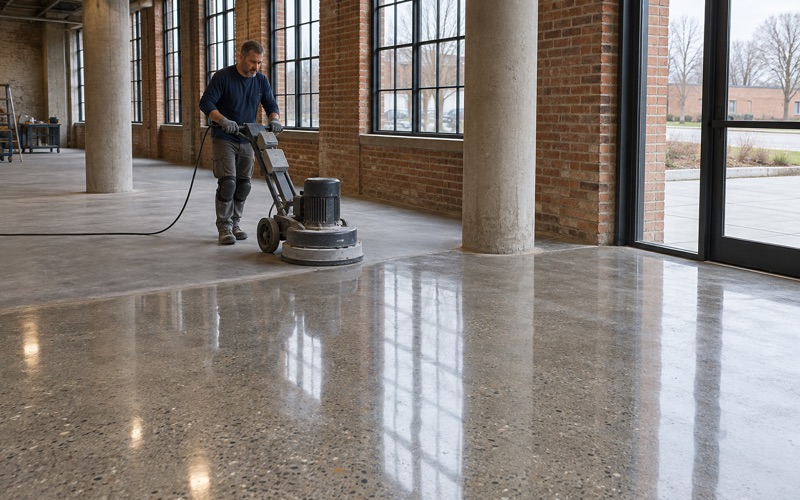
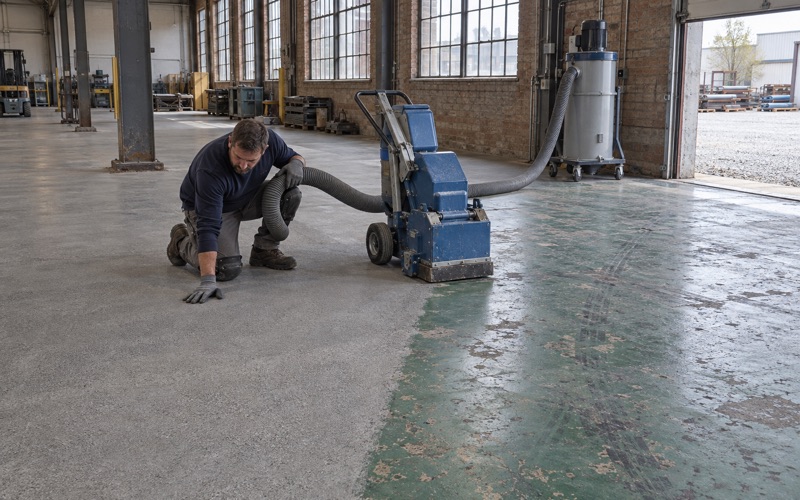
The first days of the window go to the concrete. We open it with a diamond grinder or shot blaster to the ICRI CSP profile the system calls for, and we do not acid etch. Moisture testing is a listed line item, using ASTM F1869 calcium chloride kits or ASTM F2170 in-situ relative humidity probes, so a damp slab is found before the coating goes down rather than after it blisters.
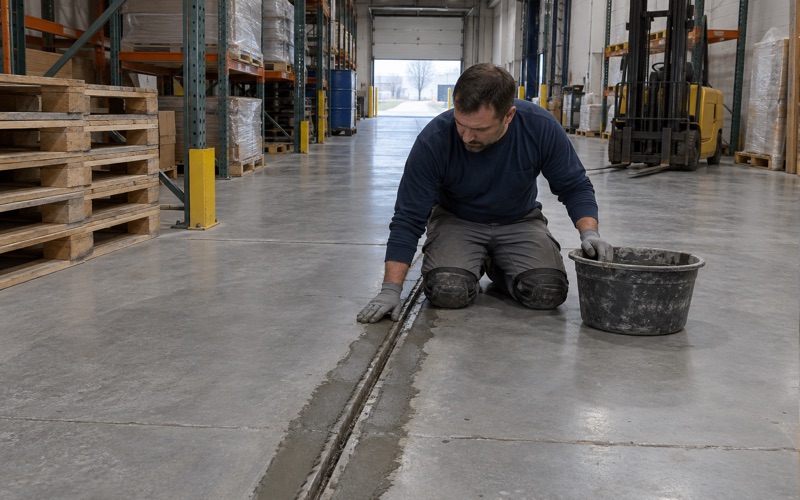
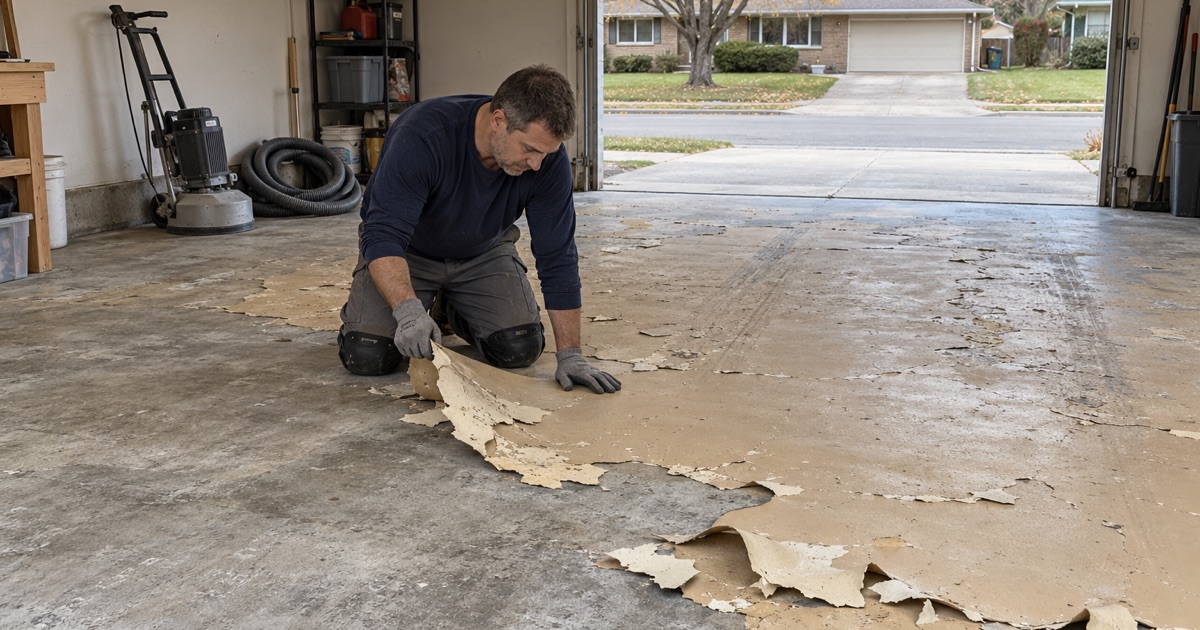
Cracks, control joints and any old coating get read at the same visit. Where a slab needs repair before it can carry a floor, the repair takes its place in the schedule, and where it needs replacement we say that plainly instead of coating over the problem. Shop and storage joints get a semirigid filler so cart and forklift wheels do not break the edges.
Choosing a System That Fits the Days Left
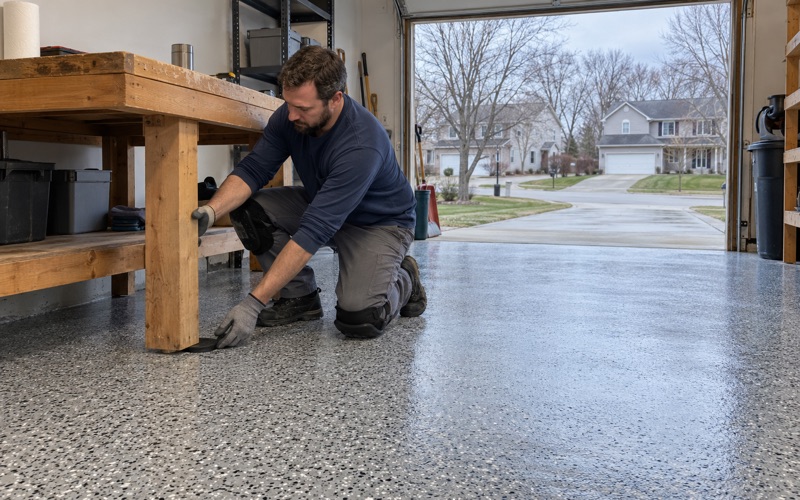
When the window is generous, a 100% solids epoxy body coat with a quartz aggregate or vinyl flake broadcast gives a thick, durable build. When it is short, a polyaspartic topcoat can shorten the return to service, though it still needs a properly prepared slab underneath. We match the system to the remaining days rather than promising one floor to every tenant.
Temperature and moisture in the room set the pace as much as the product does. We schedule each coat against slab temperature and the dew point spread at the surface, not the calendar, because amine blush and poor adhesion follow a cold, damp slab. If a vacant space has its heat turned down, we ask the landlord to bring it up days before we arrive.
Handing Back the Room
The last coat goes down with enough margin that the floor can take light foot traffic before the inspectors arrive and full loads before the tenant’s equipment does. We tell the occupant which day each step opens up, so a sign installer or shelving crew does not walk onto fresh topcoat. Overnight and weekend shifts are available when another part of the building has to keep running.
When Floor Work Becomes an Alteration
A coating laid on an existing slab is not one of the items the occupancy form lists. The form says any building, electrical, plumbing or HVAC alteration needs permits approved by the Building Inspector, and possibly State Plan Approval, before the occupancy permit is issued. That line is where some floor projects in a turnover change category.
Drains, Trenches and Moved Plumbing
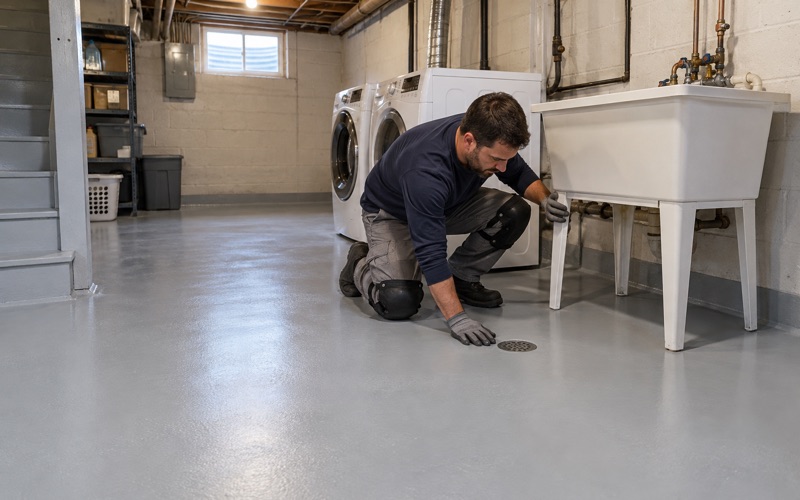
A floor drain added to a wash bay, a trench drain cut into a kitchen, or a sink relocated across a prep room is plumbing work, not coating. That work is permitted as an alteration and has to be approved before the certificate can issue, which can eat into the same 14 days. We sequence our grinding and coating after the plumber’s work is closed up and the concrete patch has cured.
Before a job is scheduled we ask the village inspector whether the scope needs a permit, because replacing a slab and coating one are different questions. A coating-only scope usually moves quickly; one that includes new drains or a cut slab does not. Knowing which one you have on the first day keeps the occupancy date realistic.
We also do not sell a floor coating as a fix for water coming up through a slab, and that matters most when plumbing work has disturbed the concrete. If a patch or a cut trench is still releasing moisture, we wait, test again, or use a moisture-mitigation primer where the readings allow it. Coating on schedule over a wet patch only trades a missed date for a failed floor.
Food Spaces and the Village Health Department
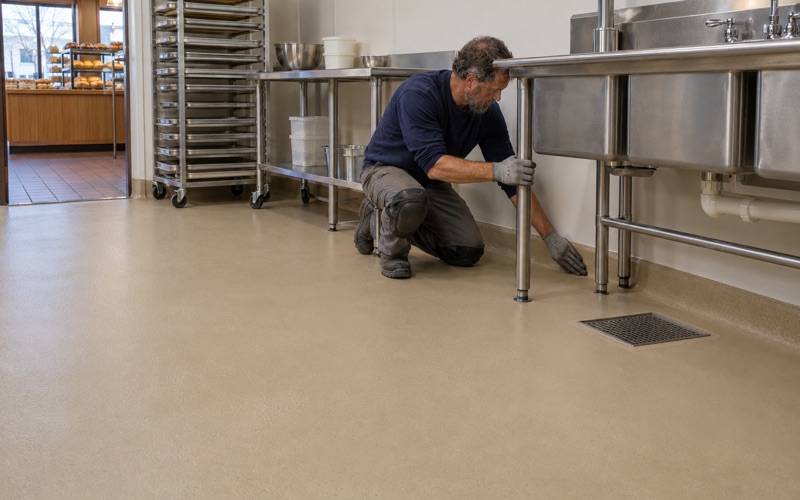
Restaurants and village retail food establishments apply for their licenses through the Village of Hales Corners, and the Hales Corners Health Department, reachable at 414-529-6155, is one of the four sign-offs on the occupancy certificate. A kitchen or prep floor needs a finish that is smooth, durable and easily cleanable. Coved floor-to-wall junctures of the kind FDA Food Code 6-201.13 describes are part of that conversation.
For those rooms we lean toward urethane cement or a quartz-broadcast epoxy with an integral cove, and we confirm the finish with the operator before materials are ordered. The health license and the floor finish are best discussed together and early. That way a kitchen is not reworked after the equipment has been set.
Repair Shops, Homes and Garages in Hales Corners
Auto repair and collision work is part of the village’s commercial mix, with shops such as Gerber Collision at 6135 S. 108th St. and Piller’s Auto Repair at 11510 W. Janesville Rd. A shop floor like that takes hot tires, jack stands, solvents, brake fluid and the brine tracked in all winter. When a shop space changes occupants, the floor work falls inside the same 14-day occupancy window as any other turnover.
Building a Shop Floor for Hot Tires and Salt
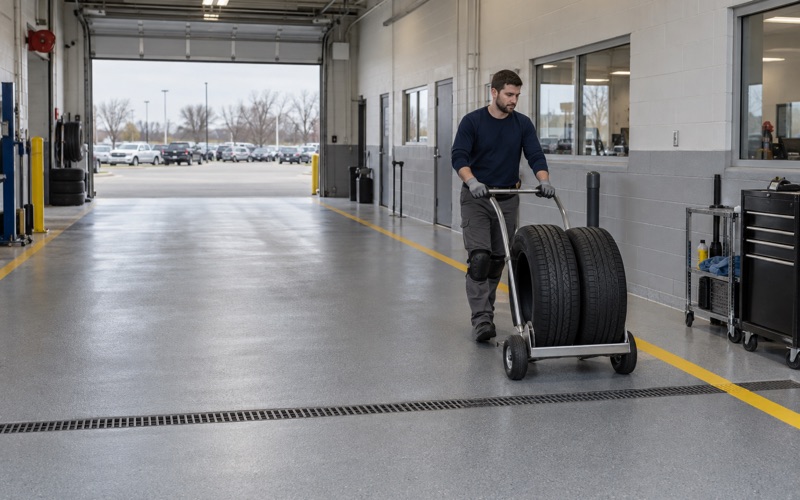
Hot tire pickup is the usual failure of a thin, rolled-on garage paint, so we build shop floors as a full system with a 100% solids epoxy or polyurea base and a polyaspartic topcoat. Calcium chloride and rock salt deicers come in on the tires all winter, which is why the topcoat and broadcast are chosen for chemical resistance rather than shine alone. Grinding slurry is collected on site rather than washed toward a storm drain.
A collision shop’s paint and prep areas raise their own questions about solvents and cleanup, so we confirm with the operator which zones need which build before quoting. Where a bay sees fluids every day, a textured broadcast keeps the floor workable when it is wet. Each zone, product and finished thickness is named in the proposal so it can be checked after the install.
Hales Corners Houses and Their Garages
Most homes in the village are owner-occupied detached houses, 1,852 of the 1,924 owner-occupied units in Census estimates, and 35.4 percent of all housing units were built in the 1950s. Slabs of that age often carry old paint, patched cracks and a history nobody wrote down. We read the concrete and test for moisture before quoting either a garage or a basement.
Wisconsin does not require a vapor retarder under an unconditioned attached garage slab, which is why we test even a floor that looks dry. Every home job gets a written contract before any deposit, as Wisconsin’s home improvement rule requires, with the products and warranty written in and the moisture exclusion read out first. When an unheated garage is too cold to cure a coating properly, we tell you it has to wait for spring.
- 20+ Years on Concrete
- Moisture Tested First
- Written Contracts