Racine Epoxy Flooring approaches epoxy flooring in Greendale with more than 20 years of grinding, priming and coating concrete behind us, and some of the floors we are asked about have to answer to someone other than the owner. Food rooms are the clearest case. A kitchen that makes product for sale beyond its own counter is held to a written state standard for its floor, and which part of that standard applies depends on more than how the floor looks today.
That is why we ask about history before we talk about color. Who holds the license, when it was first issued and whether the room has ever been resized all bear on whether a job is a recoat over sound concrete or a rebuild that adds coved edges and drains. Two kitchens with identical floors can face different requirements because of paperwork neither floor can show.
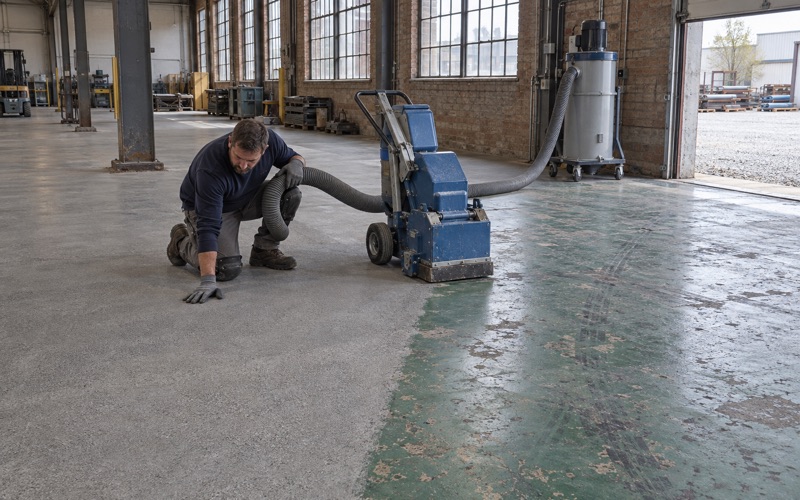
Every slab we quote is opened mechanically with a diamond grinder or shot blaster, never acid etched, and the proposal names the product, the system build and the finished thickness. We read the cracks, joints and any old coating first, and we say so when concrete needs repair before anything goes over it. The sections below walk through how that plays out for a small food maker in the village.
A Candy Kitchen in the Village Center
Apples of Eden on Broad Street
Apples of Eden sits at 5612 Broad Street in the village’s historic downtown, where long-time employees hand-dip Granny Smith apples in caramel, chocolate and nuts in small batches. The shop also sells candy, and a 2018 Shepherd Express profile described its kitchen as climate controlled. It is a useful example because its history is public, not because we have worked on or inspected its floor.
Tony and Julie Quebbemann founded the business in the late 1990s, and Beth Parkansky bought it in 2009. Under the state’s processing-plant rule, a change of operator like that is more than a business milestone. It is one of the events that decides which floor requirements a licensed kitchen is held to, and we explain why further down this page.
When a Shop Needs a Food Processing Plant License
A shop that makes food for sale beyond its own counter generally holds a food processing plant license from the Wisconsin Department of Agriculture, Trade and Consumer Protection, known as DATCP. The state’s license holder report dated October 7, 2026 lists Apples Of Eden, LLC at the Broad Street address under license 122161, in the Small Non-Potentially Hazardous category. That license is what brings the processing-plant code, ATCP 70, into a conversation about the floor.
Retail food establishments in the village go through a different office. The Village contracts with the Southwest Suburban Health Department, based in West Allis, as its agent for state food licensing and inspection, while the Greendale Health Department runs public health programs. Before we plan any food-room floor, we confirm which license the room operates under, because the finish standard follows the license.
Looking for epoxy-flooring closer to Zion? See Zion Epoxy-Flooring.
What ATCP 70.08 Asks of Every Processing Floor
Smooth, Impervious and Easily Cleanable
Wisconsin Administrative Code ATCP 70.08(2) sets the room finishes for a licensed processing plant. Floors, walls and ceilings in processing areas, toilet rooms and cleaning or storage areas must be smooth, impervious and easily cleanable, and processing-area walls and ceilings must be light colored. Every one of those surfaces must also be kept clean and in good repair.
For a coating, impervious is the word that does the most work. A seamless 100% solids epoxy over a ground slab leaves no open pores for syrup or cocoa butter to soak into, and a polyaspartic or urethane cement topcoat can follow where heat, washdown or harsh cleaners call for it. We match the system to what actually lands on the floor, not to a catalog page.
Good Repair Is an Ongoing Duty
The good-repair language does not expire once a license is issued. A chipped edge at a doorway, a coating peeling around a table leg or a crack that collects debris all work against a surface that has to stay easily cleanable. That is where a recoat usually starts: an existing room, unchanged in size, whose floor has worn past the point of cleaning well.
Before we quote one, we test for moisture as a line in the scope, using ASTM F2170 in-situ relative humidity probes or ASTM F1869 calcium chloride kits depending on the slab. A coating that blisters six months after a kitchen reopens is a worse problem than the one it replaced. Warranty exclusions get read out before the job is sold, with moisture named first.
Anti-Slip Is Allowed
The rule says directly that its smooth-and-cleanable requirement does not prohibit easily cleanable anti-slip floors. That sentence matters in any room where liquid sugar, rinse water or melted chocolate reaches the floor. Texture is permitted, but the texture still has to clean, which is a narrower target than most owners expect and the subject of the last section.
New Operator, New Rules: The 1989 Trigger
Three Events That Bring In 70.08(2)(d)
Paragraph (2)(d) of the rule adds construction items, and it applies them only to certain plants. A plant constructed or altered in a way that changes the dimensions of a processing area after June 30, 1989 must conform. So must a plant initially licensed after that date, or one licensed to a new operator after it.
That third trigger is the one owners overlook. A candy kitchen that changed hands in 2009, as Apples of Eden did, lands on the later side of the date through its license history alone. A room first licensed before mid-1989, still with the same operator and never resized, is measured against smooth, impervious, easily cleanable and in good repair.
None of this is a rule about selling a business in general, and a recoat by itself is not stated to trigger anything. DATCP decides compliance, not the contractor, and no coating settles the question on its own. What we do is ask about the license history up front so the scope matches the requirement before a price is set.
Coves at the Wall Line
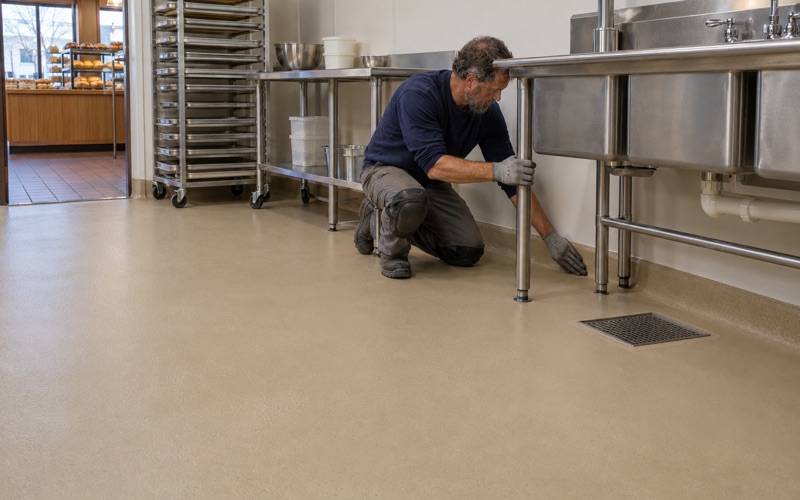
Where (2)(d) applies, wall-floor junctions in processing areas must be coved or otherwise built without a right angle. In a coating system that usually means a radius formed at the base of each wall, often in an epoxy mortar, then carried into the floor so the seam between them disappears. A square corner is where sugar, crumbs and grime collect first.
Building a cove changes the job more than people expect. Base trim comes off, wall surfaces are prepared to a set height, and the floor coating ties into the cove rather than stopping at it. In a small kitchen with equipment along most walls, that work is planned around what can be moved and what has to be worked behind.
Drains, Slope and the Mop Sink
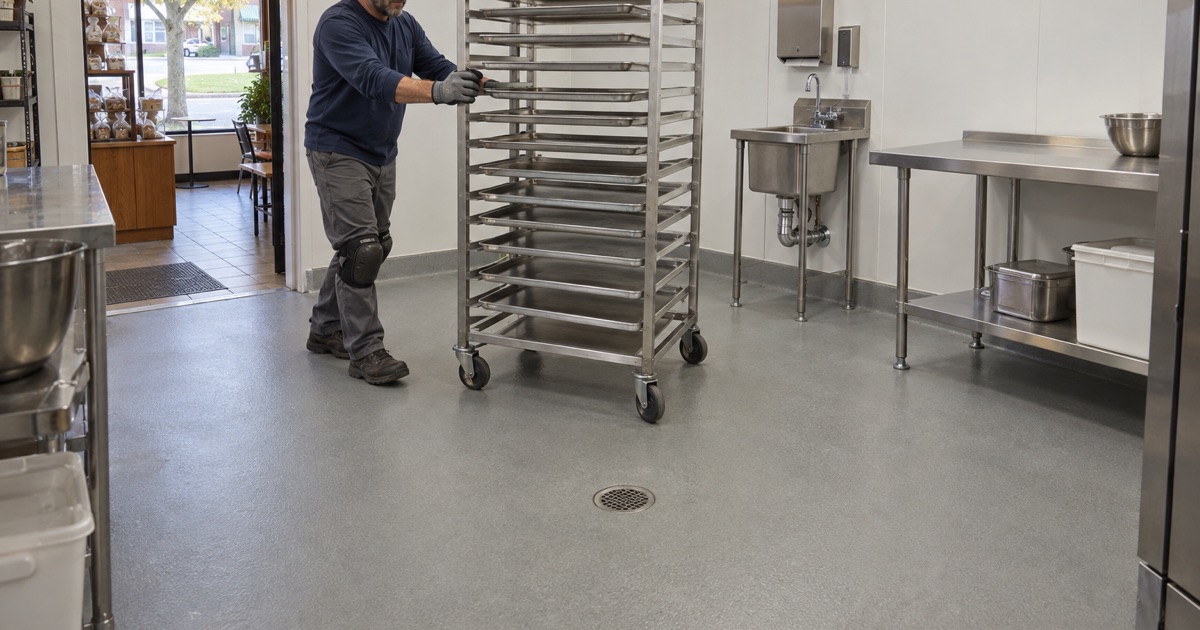
The same paragraph calls for adequate floor drains, with the floor sloped to them, where floors are water-flushed or receive liquid waste. Slope is set in the concrete, not the coating, so a flat slab that has to drain is a concrete job before it is a flooring one. We say that plainly at the quote rather than discovering it halfway through.
It also requires a service sink or a curbed floor drain for mop cleaning and mop-water disposal. A curbed drain is partly a floor detail, because the curb, the basin edge and the coating have to meet without a seam that holds water. Plumbing belongs to licensed trades in the village, so we coordinate the coating around their work rather than doing theirs.
Sticky Floors: Grip That Still Cleans
Caramel, Chocolate and Texture
A candy kitchen tests a floor in a way a garage never does. Caramel sets into whatever profile it lands on, and a coarse broadcast that grips well under wet boots can turn into a scraping job after one spill. The aim is a texture fine enough to release sugar under a squeegee and a deck brush, yet still give footing when the floor is damp.
We usually get there with a fine quartz aggregate broadcast locked under a sealing topcoat, then make a sample so the owner can feel it and clean it before the room is finished. Vinyl flake looks good in a showroom, but flake edges and deep texture give sugar more to hold. A lighter floor color also makes spills easier to spot during the daily wipe-down.
Working Around Production
Small food makers rarely have a week to close. We schedule kitchen floors around the hours the building has to keep running, including overnight and weekend windows, and we stage the work by zone when the room allows it. Curing is set against slab temperature and the dew point at the surface rather than the calendar, so a reopening date is one we can keep.
Amine blush is the quiet risk in a food room, because a waxy film left on curing epoxy can hurt topcoat adhesion and does not always show. We plan ventilation and recoat windows to avoid it. Grinding dust and slurry are collected on site and never washed toward a street drain, which matters on any block lined with storefronts.
What the Proposal Shows
Our written proposal names the product, the system build and the finished thickness, so an owner or an inspector can check what was installed against what was quoted. It also lists the moisture test, the joint and crack repairs, and any cove or drain work as separate lines. When the license history says (2)(d) applies, those items are priced in from the start, not added after a visit.
Milwaukee County sits whole-county in the Milwaukee 2015 ozone nonattainment area, and Wisconsin has no state architectural-coating VOC rule of its own, so the national limits in 40 CFR 59 Subpart D govern the products we use. For an occupied building, that is one more reason we favor low-odor systems. Ask us about a candy kitchen, bakery or processing room floor, and our first questions will be about its license.
- 20+ Years on Concrete
- Moisture Tested First
- Written Contracts