
Racine Epoxy Flooring has installed epoxy garage floor systems for more than 20 years in Racine, WI, serving surrounding cities including Mount Pleasant, Sturtevant, Caledonia, Somers and Kenosha. A garage floor here works harder than the rest of the house: it takes slush, brine, oil drips, hot tires and the full swing from summer heat to a frozen January, often in the same year the coating goes down.
That is why our garage floors start with the concrete rather than the color chart. We grind the slab, repair what needs repairing, test it for moisture and only then build a layered system on top. You get a proposal that names the resin, the build and the finished thickness, so the floor in your garage can be checked against the one you were quoted.
Below is what goes into the system, how we prepare a local slab, and the winter conditions the floor is built for. If your garage has a crack, an old peeling coating or a damp corner, that is useful to know before the estimate, not a reason to skip it.
What Goes Into a Garage Floor System
A 100% Solids Epoxy Base Coat
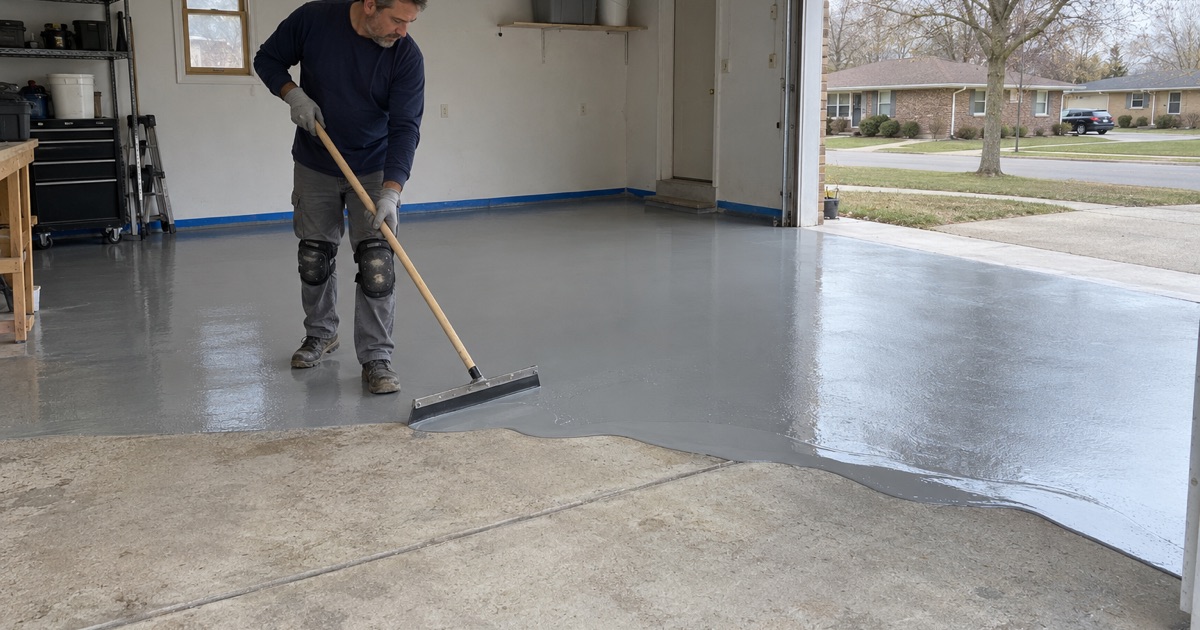
The base of most of our garage floors is a 100% solids epoxy, which means nothing in it evaporates as it cures and the thickness we roll on is the thickness that stays. That is a meaningful difference from water-based kit products, which lose much of their film as the water leaves.
A thick base fills the profile we ground into the slab, bridges hairline imperfections and gives the flake something to bed into. It is also the layer that carries most of the impact from dropped tools and floor jacks, so we do not thin it to stretch material across a larger floor.
Vinyl Flake Broadcast and Color
While the base coat is still wet, we broadcast vinyl flake across it. On most garages we do a full broadcast, covering the base completely so no bare resin shows, then scrape and vacuum away the loose chips once it has cured. That builds texture, thickness and a forgiving surface that hides dust and tire marks.
Blend and chip size are where your taste comes in. Grays and tans with a few accent colors read clean and hide road grime best, while small chips give a tighter speckle and larger chips give a bolder pattern. We bring sample boards, because a chip blend looks different on a square foot than across a two-car floor.
Polyaspartic and Polyurea Topcoats
Over the flake goes a clear topcoat, usually a polyaspartic or polyurea. These resist ultraviolet light better than epoxy, so a floor near an open door does not yellow, and they stand up to abrasion, gasoline and road chemicals better too.
The topcoat also decides the texture underfoot. A full flake floor locked in with one or two clear coats has a light grip that helps on wet days without being hard to mop. Where you want more traction, at the apron or the step into the house, we can add a fine aggregate to the final coat.
Preparing a Racine Garage Slab
Diamond Grinding to an Open Profile
We never acid etch a garage floor. Every slab is opened with a diamond grinder, or a shot blaster on larger floors, to an ICRI concrete surface profile the primer can lock into. Grinding removes the weak top skin, old sealers, curing compounds and the oil that has soaked into the tire paths.
The grinder runs with dust collection attached, so the fine concrete dust is captured at the machine rather than drifting into the house. Any slurry from wet work is collected and hauled off, and none of it is rinsed down the driveway toward a street drain.
Cracks, Control Joints and Old Coatings
Before quoting, we read the cracks, joints and any coating already on the floor. Hairline cracks and shallow pits are ground open and filled with a repair resin. Control joints are either filled or honored as straight lines in the finished floor, depending on whether the slab is still moving.
An old coating that is peeling, chalking or lifting at the edges comes off completely, because a new floor is only as strong as the layer beneath it. If a slab is broken through, heaved or badly settled, we say so plainly and talk about repair or replacement before any coating is priced.
Moisture Testing Before We Coat
Under Wisconsin’s dwelling code, SPS 322.38 calls for a vapor retarder under new house slabs but makes an exception for an unconditioned attached garage. That leaves many garage slabs sitting directly on soil with nothing slowing moisture on its way up, even when the surface looks dry.
So moisture testing is a line in our scope on every garage, not an upsell after a coating has blistered. We use an ASTM D4263 plastic sheet test, calcium chloride testing to ASTM F1869 or in-situ relative humidity probes to ASTM F2170, depending on the slab. A high reading means a moisture-mitigation primer goes down first.
Winter, Salt and Hot Tires
Brine and Calcium Chloride on the Floor
Racine streets get salted all winter, and the brine and calcium chloride ride into the garage on every tire. On bare concrete the meltwater soaks in, refreezes and scales the surface, and chlorides work deeper each season. A sealed, seamless coating keeps that meltwater on top, where it can be squeegeed out the door.
We pay particular attention to the edges where salt water collects first: the apron joint at the overhead door, the low corner by the drain and the strip along the walls. The coating runs right to those edges and up a short cove where a wall meets a wet floor.
Hot Tire Pickup and Plasticizer Migration
Hot tire pickup happens when a warm tire softens a coating and peels it off the floor as you drive away. It is the classic failure of thin, low-solids coatings, and it often shows up the first summer after a cheap job. A properly bonded, full-thickness system with a hard topcoat resists it.
Some tires also leave brown stains in the coating as chemicals in the rubber migrate into it. Polyaspartic and polyurea topcoats resist that staining far better than an epoxy finish, which is one more reason our garage floors are topcoated rather than left with a bare epoxy surface.
Cure Timing in Cold Garages
Resin cures by chemistry, and that chemistry slows sharply as a slab gets cold. We schedule each job against the slab temperature and the dew point spread at the surface, not the calendar. Coating too close to the dew point invites condensation and amine blush, a waxy film that weakens the bond between coats.
In an attached or heated garage we can work through most of the winter. In an unheated garage on a frozen slab, we tell you plainly that the job has to wait for spring rather than lay a coating that will never cure to full strength. We would rather lose a winter booking than come back to a failed floor.
Attached, Detached and Older Garages
Detached Garages on Older City Lots
A third of Racine’s housing was built in 1939 or earlier, and many of those homes have detached garages with old, thin or settled slabs. Those floors often predate any vapor barrier and may have been patched more than once. We test them carefully and look for heaving at the door and along the walls before quoting.
Whether a detached garage slab falls under the dwelling code’s vapor retarder rule is a question for the building department, so we do not assume either way. What matters for the coating is the measured moisture, which is why the test comes before the price.
When the Slab Needs Replacing First
Sometimes the honest answer is that the slab has to be replaced before anything is coated. On the City of Racine’s 2026 building permit fee schedule, replacing an accessory garage slab is a slab-only permit at $100 per slab, and starting without that permit doubles the fee. Coating an existing slab has no line on that schedule.
Before we schedule any garage job, we ask the Building Division or the village inspector whether a permit applies. If a new slab is going in, we wait for it to cure and test it like any other floor, because fresh concrete carries a lot of water.
Contracts, Products and Warranty Terms
Every home garage job gets a written contract before we take a deposit, as Wisconsin’s ATCP 110 home improvement rule requires. The contract names the products, the system build, the finished thickness and any warranty, so nothing about the floor depends on memory.
We also read the warranty exclusions out loud before the job is sold, starting with moisture. Nearly every coating warranty excludes failures caused by moisture vapor or water pressure from below, which is exactly why we measure the slab first.
- 20+ Years on Concrete
- Moisture Tested First
- Written Contracts