Racine Epoxy Flooring has spent more than 20 years putting down epoxy flooring, and in Fox Lake our attention goes to commercial floors that have to reopen on a fixed clock. A recreation business that runs public sessions cannot close for a week while a coating cures. We plan the prep, the system and the cure around the hours the building is dark, then hand back a floor that is ready when the doors open.
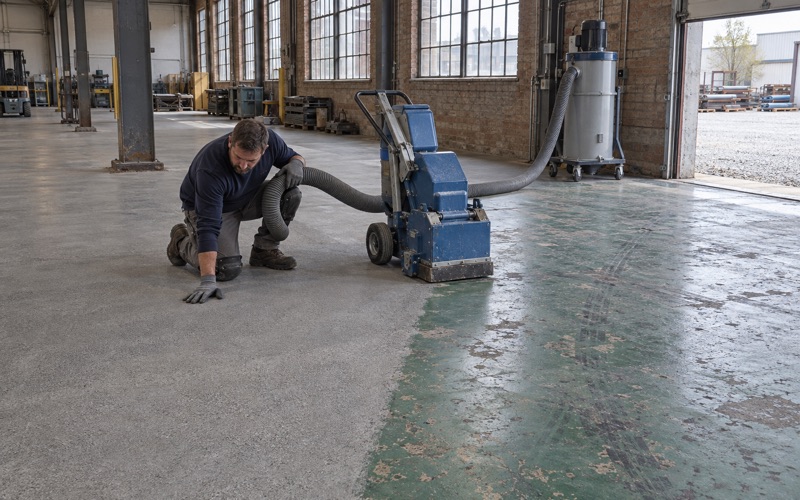
Every job starts with mechanical prep. A diamond grinder or shot blaster opens the slab to a measured ICRI surface profile, and we do not acid etch, because acid leaves residue and an uneven profile behind. Moisture testing sits in the scope as its own line item, so the condition of the slab is known before a primer is chosen rather than discovered after a blister appears.
Our proposals name the product, the system build and the finished thickness, which lets an owner or manager check what went down against what was quoted. Before any of that, we read the cracks, joints and old coating on the floor. When a slab needs repair before it can take a coating at all, we say so in plain words.
A Grand Avenue Roller Rink and the Law Behind Its Floor
Skating sessions set the schedule
Fox Lake has a family roller skating center on East Grand Avenue, Skate On Grand, with open sessions such as Tuesday evenings from 6:00 to 8:00 p.m. and Saturday afternoons from noon to 3:00 p.m. A Grand Avenue roller rink like that runs on a posted calendar that skaters and parents plan around. Floor work anywhere in a building like this has to fit between sessions, never across one.
We plan rink-building work in the windows a session calendar leaves open, including overnight and weekend gaps. A fast-cure polyaspartic topcoat can shorten the time before people walk on a floor, but only when the slab is dry and the dew point spread at the surface allows it. We tell an operator up front how many hours a given system needs before anyone in rental skates crosses it.
What the Roller Skating Rink Safety Act asks
Illinois writes rink floor duties into statute. Under the Roller Skating Rink Safety Act, 745 ILCS 72/15, the operator is responsible, to the extent practicable, for keeping the skating surface in a reasonably safe condition and for complying with the safety standards published by the Roller Skating Rink Operators Association, including proper maintenance of skating surfaces. The same section calls for at least one floor supervisor per 200 skaters.
Those duties belong to the operator, and no coating product carries them for anyone. What a flooring contractor can do is understand the obligations the owner holds, schedule around them, and avoid handing back a surface that makes them harder to meet. That is the frame we bring to any floor in a rink building.
Looking for epoxy-flooring closer to Glendale? See Epoxy-Flooring Services in Glendale.
Before Every Session: Clean, Inspect, Then Open
The pre-session inspection is the real deadline
The Act tells the operator to clean and inspect the skating surface before each session. For any floor work in the building, that inspection is the true finish date. A job that wraps up an hour before doors open, with dust still settling or a joint still soft, leaves the staff with a walk-through the floor cannot pass.
So we schedule backward from the next session rather than forward from our start time. Grinding dust and slurry are collected on site with vacuum equipment, never swept or rinsed toward a drain, and the work area is cleaned before we leave. The aim is a floor the staff can walk, wipe down and sign off on in their ordinary routine.
Cure follows the slab, not the clock
A coating that feels dry to the touch is not always ready for traffic. Cure depends on slab temperature and the dew point at the surface, and a cold slab or humid air slows an epoxy layer down or leaves amine blush on top of it. We take those readings on site and set the return time by them, not by the hour printed on a schedule.
If the readings say a coat needs longer than the gap between sessions, we say so before we start. Splitting the work across two closed windows beats opening a floor that is still curing. Most operators would rather move one session than reopen on a finish that marks under the first wave of rental skates.
Testing before the first coat
Moisture moving up through a slab is the most common reason a coating lets go, so we test before we coat. Depending on the floor, that means ASTM F2170 in-situ relative humidity probes, an ASTM F1869 calcium chloride test, or an ASTM D4263 plastic sheet test as a first look. Moisture is also the first exclusion we read out in any warranty, before the job is sold.
When readings come back high, a moisture-mitigation primer goes into the scope as a named step with its own price. We do not present a coating as a cure for water coming up through a slab. If the numbers are beyond what a primer can handle, we tell the owner that before anyone commits.
Kickboards, Risers and the Edge of the Skating Floor
Kickboards and walls
The Act also has the operator maintain the railings, kickboards and walls around the skating surface. That boundary is where the skating floor meets everything else, and it takes knocks from skates, carts and floor machines. Coating work that runs up to a kickboard has to stop cleanly at it, without a ridge, a puddle or overspray left on the board.
We mask and cut that edge by hand, and we finish the transition so the adjoining floor sits flush and smooth. A raised lip at the base of a kickboard is exactly the kind of detail a pre-session walk-through catches. It is far easier to plan out than to grind off later.
Step-up surfaces and riser coverings
In rinks where the skating surface steps up or down, the Act asks the operator to make sure the riser covering is securely fastened. A riser covering is usually its own product fastened to the step, not a coating. When our work reaches a step, we leave existing coverings and their fasteners in place and point out anything we see working loose.
Where a coating does go on the floor at the top or bottom of a step, we keep it from building up under the edge of the covering. A covering that no longer sits flat because a coat crept beneath it is no longer secure. We would rather stop the coating short and seal the line than compromise the fastening.
The skating surface is a specialty finish
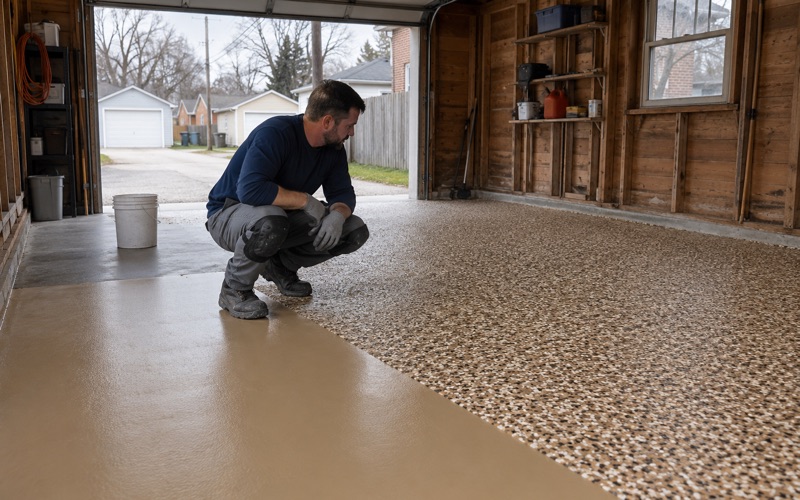
A rink skating surface is chosen for wheel grip and roll, under the operators’ association standards for skating surfaces. That is a specialty finish, and a vinyl flake broadcast built for car tires in a garage is the wrong product for it. We do not quote one for the skating floor.
If an operator asks about the skating surface itself, we say plainly that its finish belongs with a specialist in rink surfaces. Our part of the building begins where the skating surface ends, and that line is drawn in the proposal before work starts.
Lobby, Rental Counter and Snack Bar: Where a Coating Belongs
Lobby and entry floors
Off the rink, a skating center is ordinary commercial floor: a lobby, a skate rental counter, a snack area and restrooms. These are the spaces where a conventional coating fits. They take street shoes, spilled drinks and whatever comes in on boots from the parking lot.
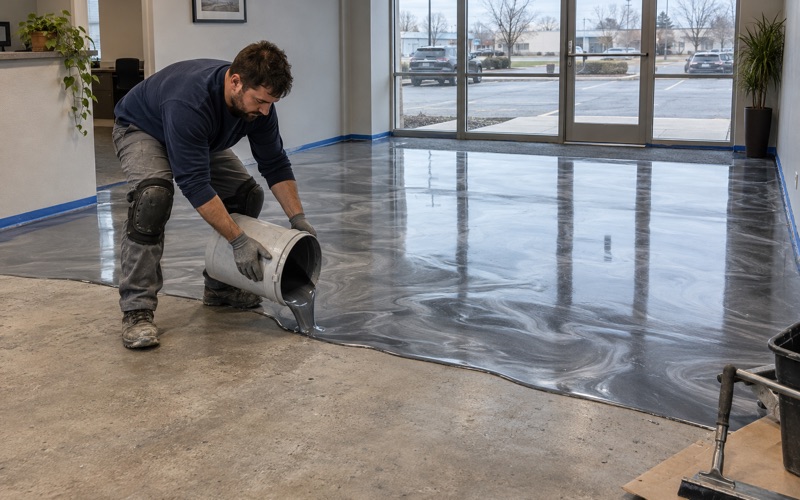
For a lobby we typically build a 100% solids epoxy base, broadcast it for texture, and finish with a polyaspartic or polyurea topcoat. A quartz aggregate broadcast gives more grip than a smooth finish where people stand in line to pay. The proposal names each layer and the finished thickness, so the system can be checked later.
The skate rental counter
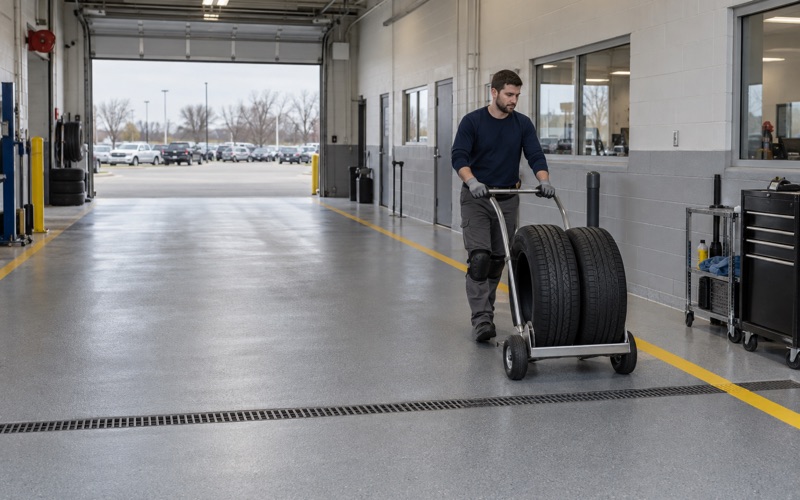
A skate rental counter sees a narrow strip of heavy use, with people sitting to lace up and staff carrying stacks of rental skates back and forth. Wheels and toe stops grind at a floor in a way shoes do not. A broadcast system under a tough topcoat holds up there far better than a thin roll-on floor paint.
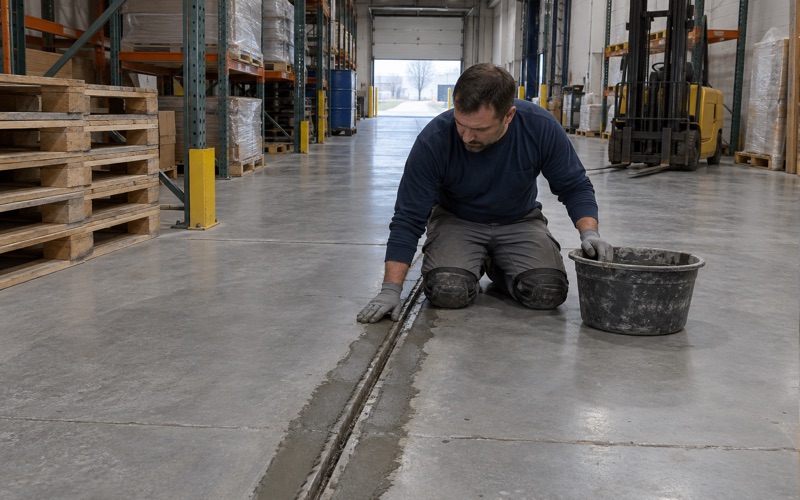
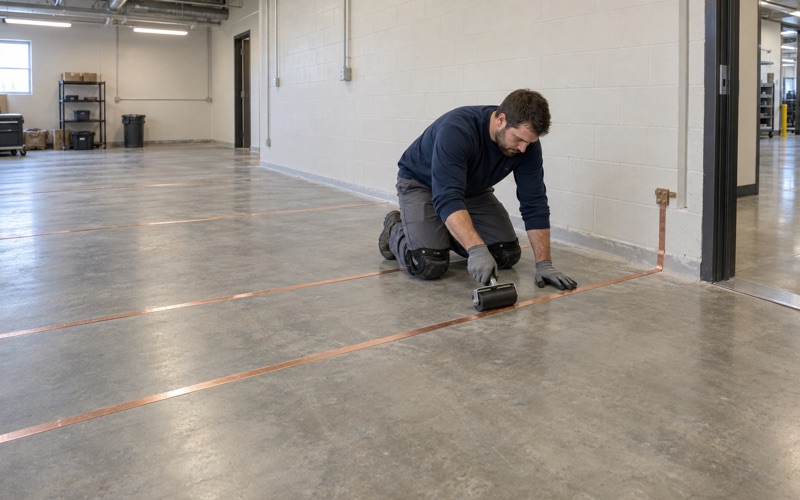
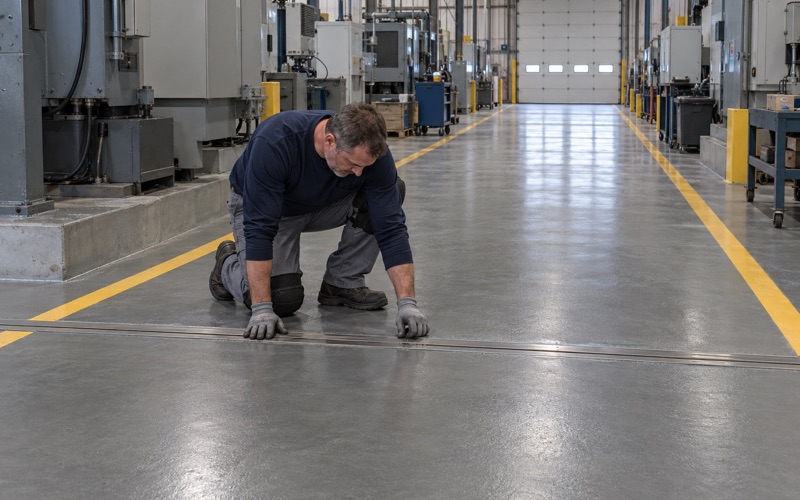
We also look at where the rental floor meets the lobby and the rink entrance. Transitions are where coatings chip first, so we cut a termination groove and set the edge into it. Control joints get a semirigid joint filler before coating, so the joint edges do not break under rolling carts.
Snack bar floors
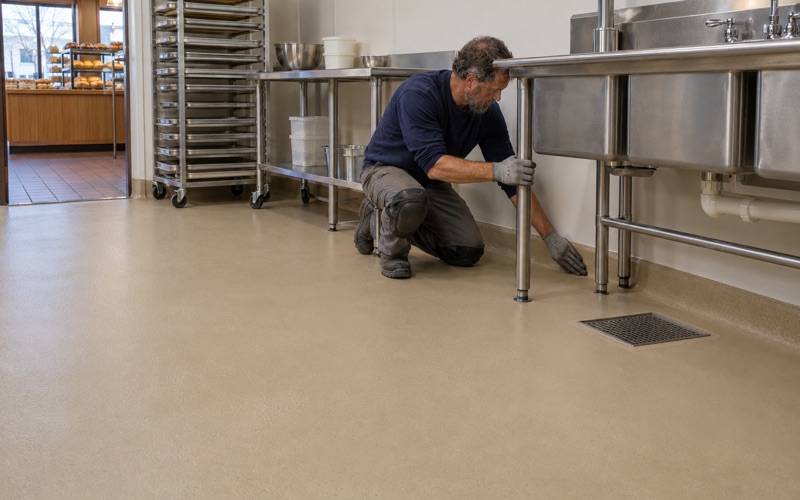
A snack area takes spilled soda, grease and frequent mopping. A seamless coating with a cove where the floor meets the wall makes that cleaning easier, and the FDA Food Code calls for coved, sealed floor and wall junctures in food areas. Whether a particular snack bar needs a health review is a question for the Lake County Health Department, which covers the Lake County portion of the village.
Before scheduling, we ask the Village of Fox Lake Community Development Department whether the floor job needs a permit. The village also asks every contractor to supply an original $10,000 surety bond, and we handle that paperwork up front rather than on the morning of the work.
- 20+ Years on Concrete
- Moisture Tested First
- Written Contracts