
Racine Epoxy Flooring provides concrete grinding in Racine, WI, serving surrounding cities including Mount Pleasant, Sturtevant, Caledonia, Somers and Kenosha, and it is the step that decides whether any coating will last. In more than 20 years of floor work, we have rarely seen a coating fail because the resin was bad. We see them fail because the concrete underneath was never properly opened.
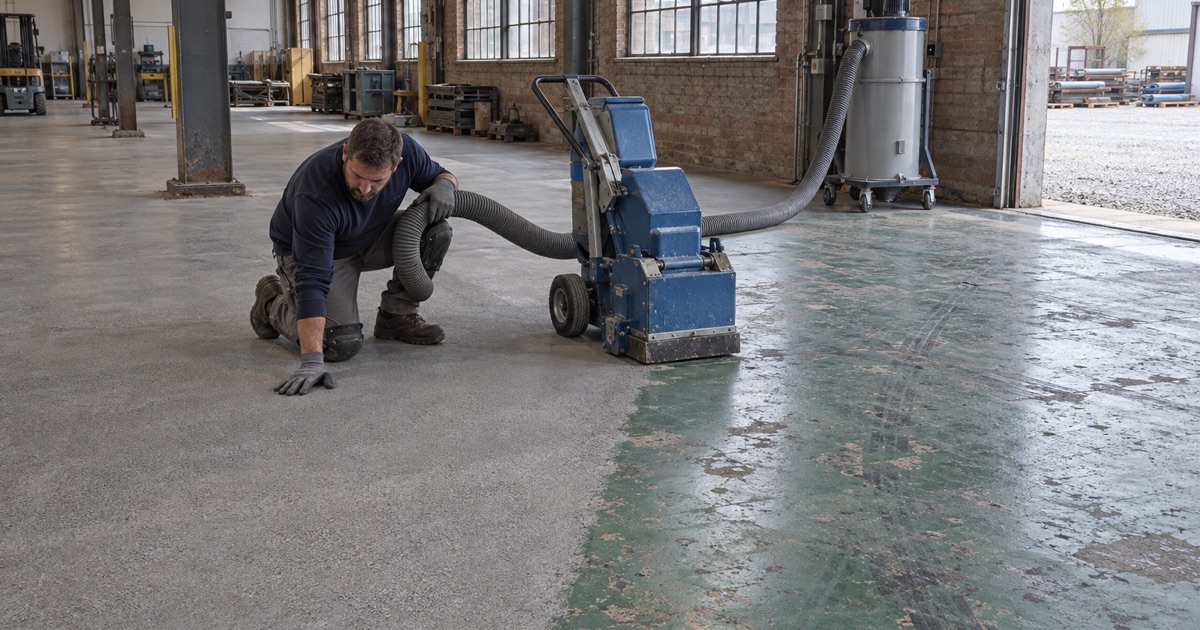
Every slab we coat is prepared mechanically with a diamond grinder or a shot blaster. We do not acid etch. We also grind as a standalone service: removing old coatings, mastic and wax, flattening high spots and preparing slabs for other flooring trades.
Why Grinding Instead of Acid Etching
What an Acid Etch Leaves Behind
Acid etching dissolves a thin layer of cement paste to roughen the surface. It works unevenly, attacking soft areas more than hard ones, and it does nothing to sealers, curing compounds, paint, wax or oil. A coating applied over any of those bonds to the contaminant, not the concrete.
Etching also has to be neutralized and rinsed, which pushes water back into the slab right before coating, and leftover salts can interfere with adhesion. That is why it is common with do-it-yourself kits and why we do not use it.
Surface Profiles and the ICRI CSP Scale
The International Concrete Repair Institute publishes a scale of concrete surface profiles, CSP 1 through CSP 10, from nearly smooth to very rough. Coating manufacturers specify which profile their primer needs, and thicker systems usually need a deeper profile.
We grind to the profile the chosen system requires and check it against reference chips, rather than estimating by eye. A thin sealer needs only a light profile, while a heavy urethane cement or a thick resin mortar needs much more tooth.
Diamond Grinding and Shot Blasting
Diamond Grinding for Most Floors
A diamond grinder uses rotating heads fitted with diamond tooling to cut the surface. Changing the tooling changes the result: aggressive segments strip coatings and flatten high spots, while finer tooling refines the surface for thin coatings or polishing.
Grinders reach close to walls and around obstacles with edge grinders, and they work well on garages, basements, small shops and residential floors. They also flatten lips at cracks and joints, which matters for thin, glossy finishes such as metallic epoxy.
Shot Blasting for Large Open Areas
A shot blaster throws small steel shot at the concrete, then recovers the shot and the debris into a dust collector. It produces a uniform profile quickly over large, open areas such as warehouses, plants and parking decks.
Shot blasting suits floors that will take thicker coatings, and it can clean a large slab faster than grinding. It does not reach tight edges or flatten uneven floors, so on most commercial jobs we combine it with grinders for edges, ramps and transitions.
Removing What Is Already on the Floor
Old Coatings, Mastic and Adhesive
Failing coatings, paint, tile mastic and carpet adhesive all have to come off before a new floor goes down. Heavy tooling removes thick coatings, while special segments handle gummy mastics that would otherwise load up the diamonds.
We test old coatings and adhesives before removal where their age suggests they could contain asbestos or other hazardous materials, and we will not grind a suspect material until it has been checked.
Wax, Floor Finish and the Water Test
Waxed and finished floors are common in older offices, schools and basements, and they will not hold a resin coating. Manufacturer instructions require removing wax, floor compounds and curing agents before coating. A quick check is to pour water on the floor: if it beads instead of soaking in, the surface needs abrading.
Acid will not remove wax, and stripping alone often leaves residue in the pores. Grinding through the finish to fresh concrete is the reliable answer, and we confirm the result with another water test before priming.
Oil, Grease and Contaminated Slabs
Garage and shop slabs often carry years of oil, grease and coolant soaked into the surface. We degrease heavily contaminated areas, then grind through the stained layer and test whether contamination remains deeper in the slab.
Some oil-soaked areas need repeated cleaning and grinding before a coating can bond. If contamination goes too deep to remove, we tell you and talk about options, rather than coating over a spot that will lift later.
Dust, Slurry and a Clean Site
Capturing Dust at the Machine
Concrete grinding creates fine dust that includes crystalline silica. Our grinders and shot blasters run with industrial vacuums attached, capturing dust where it is made rather than letting it drift through a house or workspace.
In occupied buildings, we add plastic barriers and plan the loudest, dustiest steps for times when fewer people are nearby. The goal is a work area you can walk past without wiping down every surface afterward.
Handling Slurry and Waste
Wet grinding produces slurry, a mix of water and concrete fines. We collect it on site and dispose of it properly. Grinding dust and slurry are never washed toward a street drain, the Root River or Lake Michigan.
Old coatings and debris removed from the floor are bagged and hauled away as part of the job. When we leave, the floor is ready for repair, coating, polishing or another trade’s installation, with nothing left in the drains.
- 20+ Years on Concrete
- Moisture Tested First
- Written Contracts