
Racine Epoxy Flooring handles concrete floor repair in Racine, WI, serving surrounding cities including Mount Pleasant, Sturtevant, Caledonia, Somers and Kenosha, as both a standalone service and the first stage of every coating we install. Over more than 20 years we have learned that most coating failures start as an unrepaired slab: a crack that kept moving, a spall that was filled with the wrong material or a joint that was simply painted over.
We read the cracks, joints, surface damage and any old coating before quoting, and we say plainly when a slab needs replacing rather than repairing. Below is how we approach the most common problems on garage, basement and shop floors around Racine.
Reading Cracks Before Filling Them
Shrinkage Cracks and Settled Slabs
Most slabs crack as the concrete shrinks while it cures, leaving fine lines that run across the floor or out from corners. Once the concrete has finished shrinking, those cracks usually stop moving. We grind them open, clean them out and fill them with a rigid epoxy or polyurea repair material ground flush with the floor.
Cracks that widen at one end, step down from one side to the other or show fresh broken edges tell a different story. They often mean the slab has settled or is still moving. We check the base and drainage around those cracks before deciding how to treat them.
Moving Cracks Treated Like Joints
A crack that opens and closes with the seasons will reopen through a rigid fill and through any coating laid over it. For those, we use a semirigid or flexible filler that can move a little without breaking its bond, and we may honor the crack as a line in the finished floor.
That is the same approach used on control joints. Trying to hide a moving crack completely usually ends with a visible crack in a new coating a year later, so we would rather tell you up front which lines will stay visible.
Spalls, Pitting and Salt Scaling
Salt Scaling on Garage Floors
A Racine winter sends brine and calcium chloride into garages on every tire. When that salt water soaks into concrete and freezes, it pops off thin flakes of the surface, a condition called scaling. Garage floors often show it first in the tire paths and at the overhead door.
We grind away the loose, weakened surface until we reach sound concrete, then rebuild the profile with a polymer-modified repair mortar or resin patch. Sealing or coating the repaired floor is the step that keeps the salt water out, so scaling does not simply return next season.
Spalls, Pop-Outs and Impact Damage
Spalls are deeper chips and broken areas, often at joints, around drains and where heavy objects have been dropped. Pop-outs are small cone-shaped holes left when a piece of aggregate near the surface fails. Both leave sharp edges that catch tires and collect water.
We saw or grind the edges of a spall to a clean, square shoulder rather than feathering a patch out to nothing, because thin feathered edges break first. The repair material is chosen for the depth: resin mortars for shallow damage and cementitious repair materials for deeper sections.
Joints, Edges and Doorways
Filling Control and Construction Joints
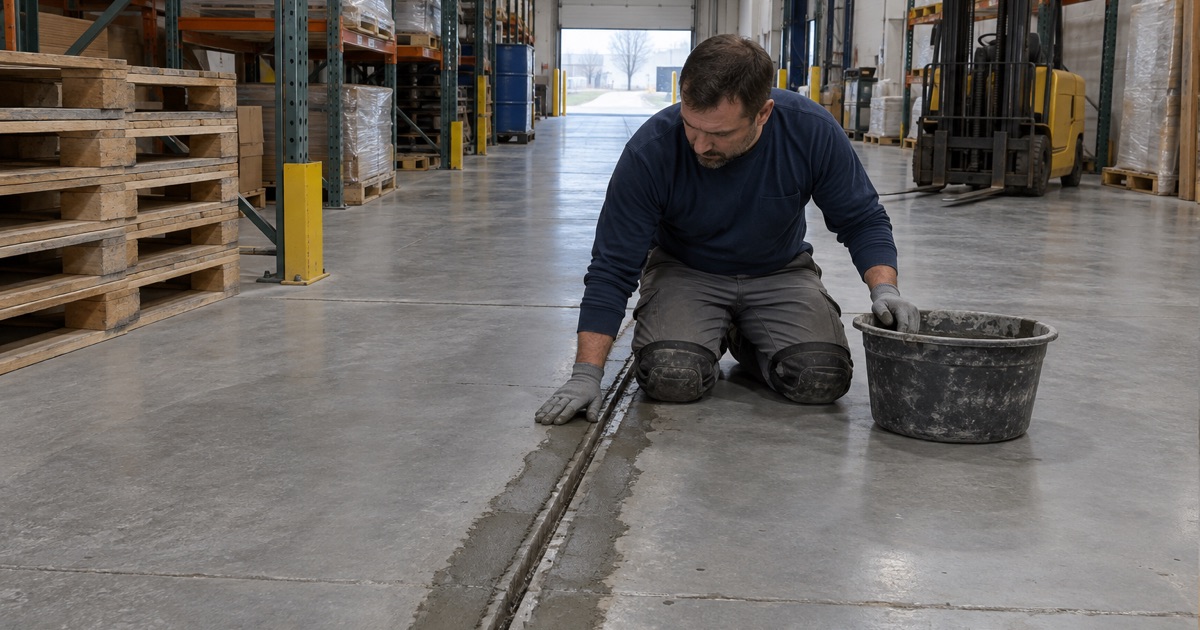
In shops, warehouses and plants, joints take the most punishment. Hard forklift and cart wheels hit the open edges and chip them away, until the joint becomes a trench. We clean out failed fillers and fill joints with a semirigid joint filler that supports the edges while allowing a small amount of movement.
In garages, joints are usually less abused, but they collect dirt and salt water. Filling them before a coating gives a smooth, continuous floor, while leaving them open preserves their function on a slab that is still moving. We decide case by case.
Garage Aprons and Door Edges
The strip along an overhead door takes snowmelt, salt and the weight of every vehicle crossing the threshold. It is often where a garage slab is most damaged, and where it meets the driveway apron it may have heaved or settled with frost.
We repair scaled and broken edges at the door and seal the joint between the garage slab and the apron with a flexible material so meltwater does not run underneath. Where the apron itself has heaved badly, that is usually a replacement question rather than a repair.
When Repair Is Not Enough
Uneven Floors and Self-Leveling Underlayment
Some floors are sound but uneven, with low spots that hold water or humps that make a coating look wavy. Light unevenness can be ground down. Deeper low areas can be built up with a self-leveling underlayment or a resin mortar to bring the floor back to a flat, consistent plane.
This matters most under metallic epoxy and polished finishes, which reveal every wave in the slab. Under a flake coating the tolerance is wider, so the level of correction we recommend depends on the finish you plan.
Replacing a Slab and the Permit Question
A slab that has broken into pieces, heaved significantly or settled more than a repair can correct needs replacing. On the City of Racine’s 2026 building permit fee schedule, replacing an accessory garage slab is listed as a slab-only permit at $100 per slab, and starting without that permit doubles the fee.
We ask the City of Racine Building Division, or the village inspector outside the city, whether a permit applies before any job is scheduled. A newly poured slab then needs time to cure and dry before it is tested and coated, so we plan the schedule around that from the start.
- 20+ Years on Concrete
- Moisture Tested First
- Written Contracts