
Racine Epoxy Flooring installs commercial epoxy flooring in Racine, WI, serving surrounding cities including Mount Pleasant, Sturtevant, Caledonia, Somers and Kenosha, for businesses that cannot simply lock the doors for a week. After more than 20 years on commercial and residential slabs, we treat the schedule as part of the floor: the system, the phasing and the return-to-service time are planned together.
This page covers retail, office, automotive and institutional floors. Heavy manufacturing, food plants and restaurant kitchens have their own pages, because their chemicals, temperatures and inspections change the system entirely.
Matching the System to the Business
Retail Stores, Showrooms and Offices
Retail and office floors need to look sharp under display lighting, clean quickly and survive carts, chairs and constant foot traffic. A seamless epoxy floor with a polyaspartic topcoat delivers that, and colors can be chosen to match a brand palette or define sales areas.
For showrooms, metallic or high-gloss solid colors give a premium look. For back-of-house stockrooms and corridors, a satin finish with a light flake hides scuffs. Many businesses use both, keeping the showpiece finish where customers walk.
Auto Service Bays and Dealership Shops
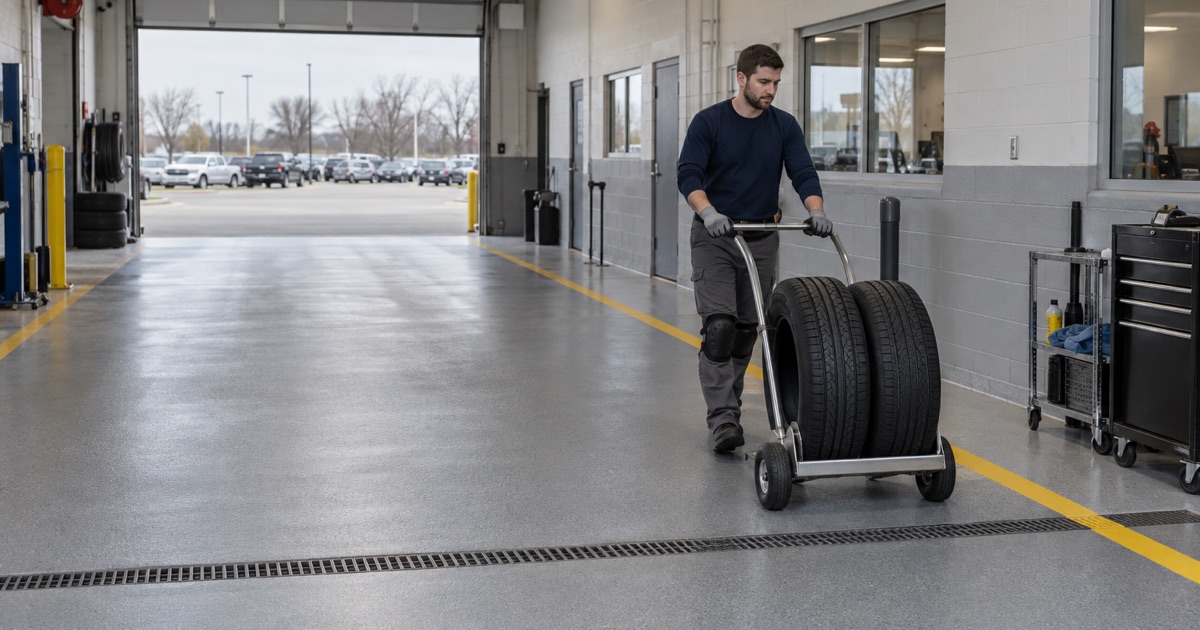
Service bays take oil, coolant, brake fluid, tire dressing and the occasional dropped tool, plus the brine and salt that come in on every vehicle in winter. Hot tires from vehicles that just came off the road can lift a weak coating. We build these floors with a thick 100% solids epoxy base and a chemical-resistant topcoat.
We pay attention to trench drains, lift anchors and the strip inside the overhead doors, where meltwater pools and coatings usually fail first. Quartz texture can be added where techs need grip on a wet floor.
Clinics, Schools and Public Buildings
Clinics, schools, daycare centers and public buildings need floors that clean easily and withstand heavy traffic without long closures. Resin floors suit corridors, restrooms, mechanical rooms and labs, and coved bases at the walls make cleaning simpler.
These buildings rarely close, so we phase room by room and use lower-odor systems near occupied spaces. We coordinate with facilities managers on access, ventilation and the order in which areas return to use.
Keeping the Business Running
Overnight, Weekend and Phased Installs
We plan the work around the hours the building has to keep running. That might mean coating one aisle a night, closing a department over a weekend or finishing a service bay between shifts. Fast-curing polyaspartic systems help when the window is short.
The phasing is drawn up with you before the job is priced, so the proposal reflects real working hours. Night and weekend work can change the price, and we show that as its own line rather than hiding it.
Odor, Ventilation and VOC Content
Resin systems vary in odor and volatile organic compound content. In an occupied building, we favor low-odor, low-VOC products, ventilate the work area and seal it off from the rest of the space where we can. Every product we use meets the national architectural coatings rule in 40 CFR 59 Subpart D.
Racine County lies partly within the Milwaukee 2015 ozone nonattainment area, and jobs across the Illinois line fall under that state’s architectural coating VOC limits in 35 Ill. Adm. Code Part 223 Subpart C. We check product VOC content against the job’s location before ordering.
Dust, Slurry and Clean Work Areas
Grinding a commercial slab produces fine concrete dust. Our grinders run with vacuums attached, capturing dust at the machine, and we isolate work areas with plastic barriers where stock or equipment must stay nearby.
Wet slurry and waste are collected on site and hauled away. Nothing is washed toward a parking lot drain, the Root River or Lake Michigan, which matters to property managers and to anyone with a stormwater plan to keep.
Specifications and the Paper Trail
What the Proposal Names
Every commercial proposal names the products, the system build layer by layer and the finished thickness. That allows a facilities manager or general contractor to compare quotes on equal terms and to check later that what was installed matches what was bought.
We can provide manufacturer data sheets and safety data sheets for the file. When a job is part of a larger renovation, we work from the project specification and flag anything in it that conflicts with the slab conditions we find.
Joints, Drains and Existing Conditions
Before quoting, we read the joints, cracks, drains and any old coating or tile. Joints that carts and pallet jacks cross are filled with a semirigid filler so the edges do not chip. Failing coatings and old mastic are ground off rather than covered.
We also test for moisture, because many commercial slabs were poured without a vapor retarder or have one that has failed. A moisture-mitigation primer is priced as its own line when readings call for it.
Slip Resistance and Upkeep
Texture Where Floors Get Wet
Entrances, restrooms, service bays and wash areas need more grip than a smooth gloss floor offers. We add aggregate to the topcoat in those zones, choosing a grit that balances traction against how easily the floor can be cleaned.
Texture can be limited to the wet areas while dry sales floors and offices keep a smoother finish. We mark those zones on the plan so everyone knows where the textured areas start and stop.
Cleaning and Long-Term Care
A commercial resin floor is cleaned with an auto scrubber or mop and a pH-neutral cleaner, with daily dust mopping to keep grit from scratching the topcoat. It does not need stripping and waxing like vinyl tile.
When traffic lanes eventually dull, the topcoat can be screened and recoated over a weekend without removing the full system. We leave written care instructions so the floor is treated the same way regardless of who is cleaning it.
- 20+ Years on Concrete
- Moisture Tested First
- Written Contracts