Racine Epoxy Flooring brings more than 20 years of epoxy flooring work to Burlington, and the jobs we take most seriously here are the rooms where a surface has to be cleaned hard every single day. Exam rooms, treatment areas and boarding spaces ask more of a coating than a showroom does. A floor that looks fine but holds grime in a chipped edge is not finished work.
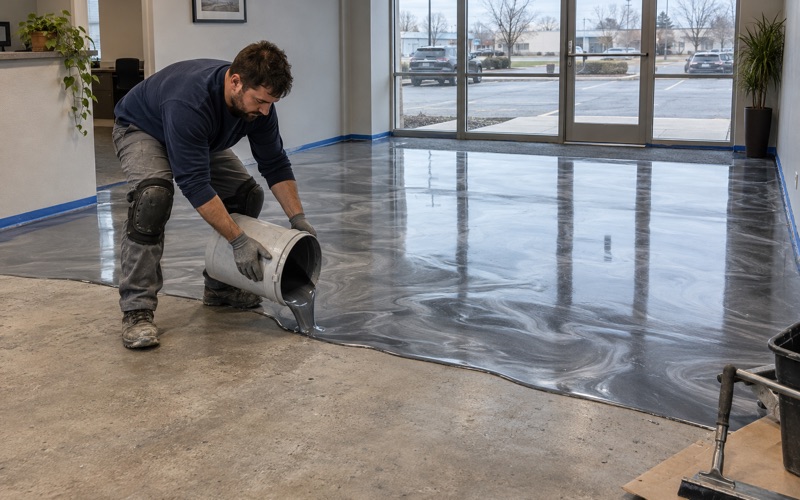
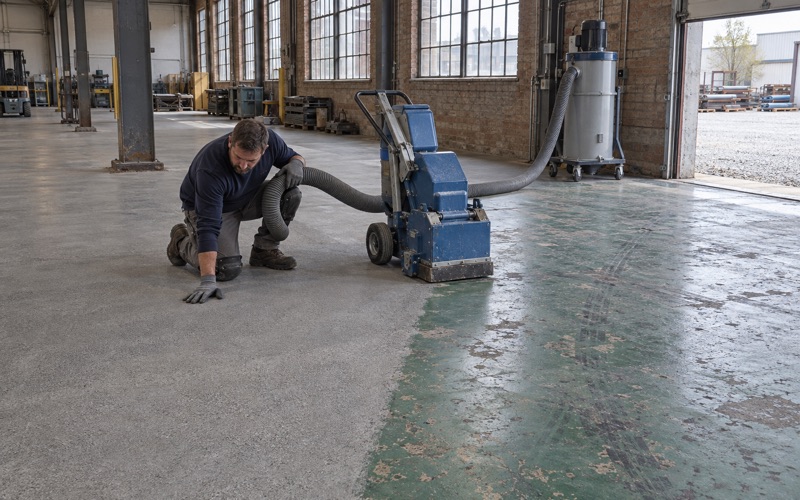
Every slab we coat is opened with a diamond grinder or a shot blaster first, never acid etched, because adhesion is what keeps a coating from lifting at the edges where mops and wet vacuums work. The proposal then names the product, the system build and the finished thickness. That way an owner can check what was quoted against what actually went down.
We also read the cracks, joints and old coating before we price anything, and we say plainly when a slab needs repair before it can be coated. Moisture testing sits in the scope as its own line, using ASTM F1869 calcium chloride tests or ASTM F2170 in-situ relative humidity probes. Warranty exclusions are read out before the job is sold, and moisture is the first one named.
A Pet and Bird Clinic on North Pine Street, and Wisconsin’s Sanitation Rule
Burlington is a city of 11,047 people as of the 2020 census, spread across Racine and Walworth counties with most of it in Racine County. Downtown, Molitor Pet & Bird Clinic at 108 N. Pine Street treats dogs, cats, birds, reptiles, ferrets, rabbits and rodents. It also handles surgery, digital radiographs, an in-house lab and ultrasound, and it boards cats.
Avian and Exotic Patients Change the Room
A clinic that sees birds and reptiles alongside dogs and cats runs a busier mix of rooms than a single-species practice. Feathers, bedding, substrate and food land on the floor, and the cleanup that follows uses the same disinfectants several times a day. We treat that clinic as a reference point for what a Burlington animal-care floor has to survive, not as a past customer of ours.
That last point matters for anyone reading this page. We have not coated or inspected that clinic’s floors, and we name it only because it shows the kind of practice operating downtown. Any animal-care owner in the city faces the same daily cleaning load and the same questions about what the floor underneath can take.
VE 1.58(21): Clean and Sanitary Is a Conduct Rule
In Wisconsin, the veterinary unprofessional conduct rule is Wis. Admin. Code VE 1.58, created by CR 21-062 and effective August 1, 2022. Subsection (21) makes it unprofessional conduct to fail to keep the veterinary facility and all equipment, including mobile units, in a clean and sanitary condition. That places housekeeping in the same rule as the other conduct questions a veterinarian answers for.
The floor is part of the facility, so a coating that has chipped, peeled at a joint or opened along a wall is more than a cosmetic flaw. It is a spot where cleaning stops working as intended. The older rule, VE 7.06, has since been repealed, but a 2014 board order applied it to a clinic that used its lobby as a treatment and recovery area.
Looking for epoxy-flooring closer to Lindenhurst? See Epoxy-Flooring in Lindenhurst.
When the Board Can Walk In
Subsection (22) of the same rule covers the other half of the risk. A veterinarian who fails to permit the Veterinary Examining Board or its agents to enter and inspect the practice facilities, vehicles, equipment and records during office and other reasonable hours commits unprofessional conduct. In plain terms, a Veterinary Examining Board inspection can happen on an ordinary working day, with patients in the building.
The Floor Has to Be Ready Every Day
That timing is why we do not think of a clinic floor as something to tidy up before a visit. A surface that only presents well after a deep clean is the wrong surface for a room that may be seen at any reasonable hour. The goal is a floor that looks the same on a Tuesday afternoon as it did the morning it was cleaned.
No coating makes a practice compliant, and no floor passes or fails anything on the owner’s behalf. What a well-built floor can do is remove the obvious defects, such as chips, open seams and worn traffic lanes, so the clinic’s own cleaning routine has a continuous surface to work on. Whether a facility meets the rule remains the veterinarian’s responsibility and the board’s call.
Defects We Look For Before Quoting
Before we price a clinic floor we walk every room and mark what the existing surface is doing. We look for coating lifting at door thresholds, cracks telegraphing through, joints that have opened and edges where a wet vacuum has worn the film thin. When the slab itself needs repair before any coating will hold, we say so in writing rather than coating over the problem.
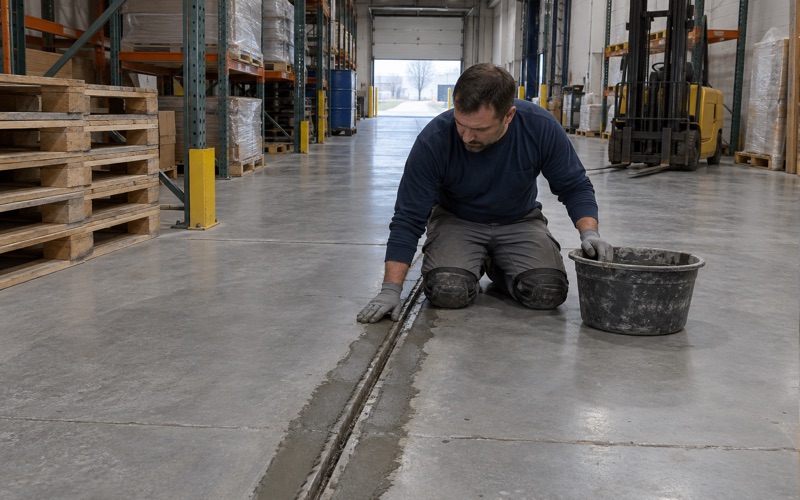
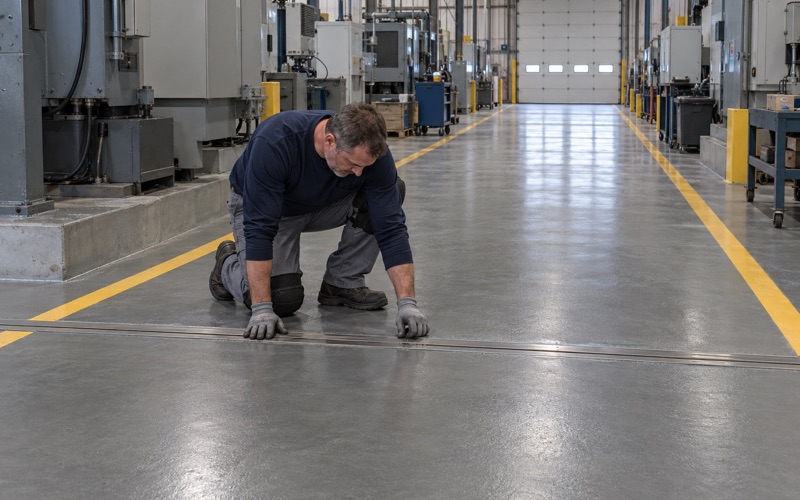
Joints get particular attention in treatment and boarding rooms. We fill them with a semirigid joint filler before the system goes down, so cart wheels and rolling exam tables do not break the edges. A joint left open becomes a line of debris that no mop reaches, which is exactly the kind of gap a sanitation rule is written about.
Exam, Surgery-Prep and Cat-Boarding Floors That Take Disinfectant
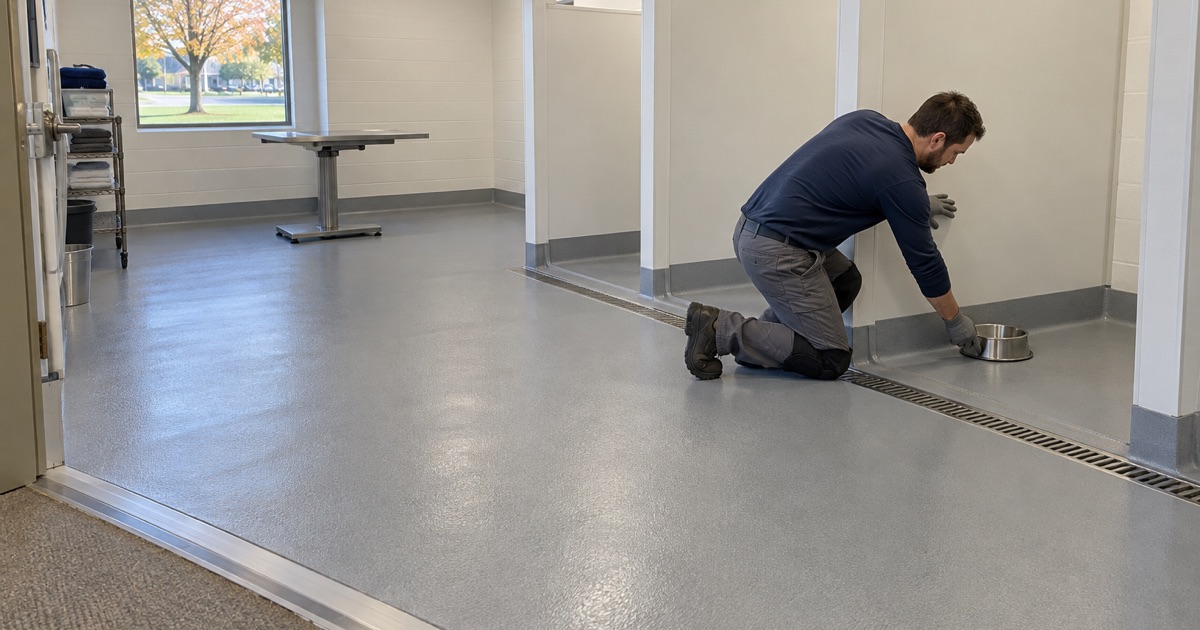
Each room in an animal clinic asks for a slightly different build, and we write the system to the room rather than running one product wall to wall. All of them share the same starting point: a mechanically profiled slab, tested for moisture, with a coating that forms one continuous surface. From there the topcoat, texture and edge detail change with what happens in the room.
Exam and Treatment Rooms
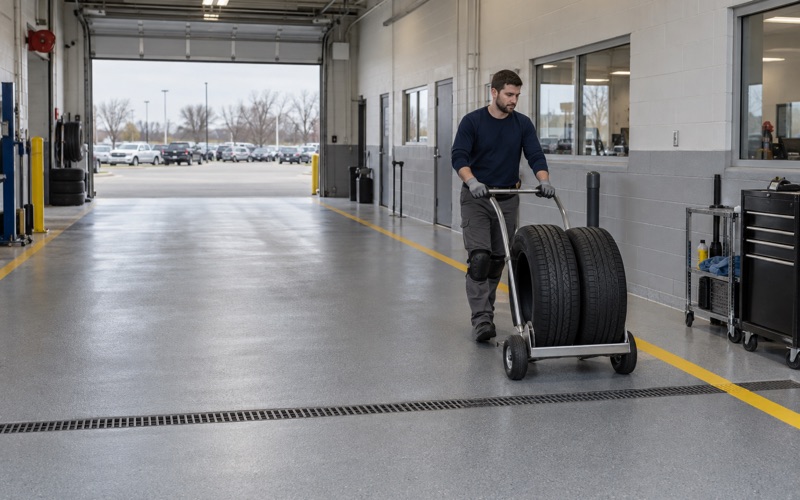
Exam and treatment rooms take the most traffic and the most frequent wipe-downs. We generally build these with a 100% solids epoxy base for thickness, then a polyaspartic or polyurea topcoat chosen for chemical resistance against the disinfectants the clinic actually uses. We ask for the product list up front so the topcoat is matched to it rather than guessed.
Texture is a balance. A fine quartz aggregate broadcast gives footing for staff and animals on a wet floor, while a coarse one makes cleaning harder and holds residue in its profile. We set the texture so a mop still glides across it, and a sample board lets the clinic feel the difference before anything is committed.
Surgery-Prep Rooms
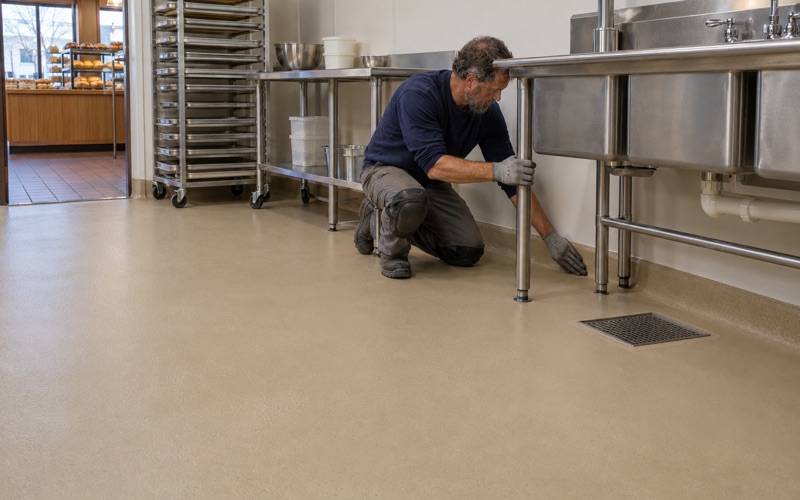
Surgery-prep rooms are where a chipped coating matters most, because the area is cleaned to a higher standard than the hallway outside it. We pay close attention to the wall junction, carrying the system up into an integral cove where the room calls for one so the floor and base read as one surface. Penetrations for equipment are sealed rather than left as raw concrete edges.
We do not describe any of these floors as antimicrobial, and we make no claim that a coating stops disease. The case for a seamless surface is simpler than that: there is less for a cleaning crew to miss, and the disinfectant reaches the whole floor instead of stopping at a crack. That is a claim we can stand behind on a written scope.
Cat-Boarding Rooms
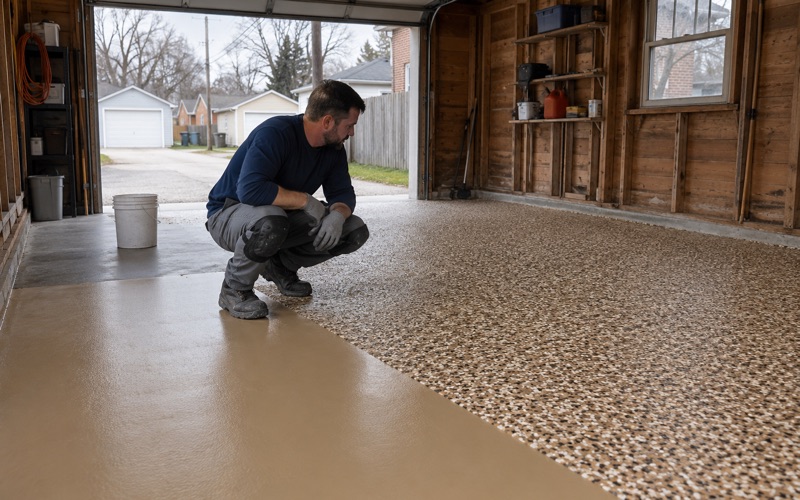
Boarding rooms see litter, spilled water and food bowls moved around all day, with cats staying several nights at a time. A vinyl flake broadcast under a clear topcoat hides minor scuffs between deep cleans while staying smooth to wipe. We keep the edges tight at cabinet bases and enclosure legs, which is where litter tends to gather.
Enclosures also have to come out of the room for the work. Moving them is part of our schedule, and we set them back only after the topcoat has cured enough to take their weight without marking. A floor that is reopened too soon picks up dents and scuffs that stay for the life of the coating.
Working Around a Thursday-and-Sunday Closure
The downtown clinic’s posted hours show how a practice schedule shapes floor work. It is open Monday, Tuesday, Wednesday and Friday from 8:00 a.m. to 5:00 p.m. and Saturday from 8:00 a.m. to noon, and it is closed Thursday and Sunday. Those closure days are the natural windows for floor work in a clinic like it, though how much fits into one is our planning estimate.
Fitting Cure Time Into a Closed Day
A full grind, prime and multi-coat system rarely fits into one day with time left to cure before patients return. We usually phase a clinic room by room, so one exam room is coated on a Thursday and the next on a Sunday while the rest of the building keeps working. Curing is scheduled against slab temperature and dew point rather than the calendar.
Fast-curing polyaspartic topcoats help where a room must reopen the next morning, but they are not a shortcut past surface preparation. Rushing a coat in cold or damp conditions invites amine blush, outgassing and pinholes, which leave exactly the small defects a sanitation-focused floor is supposed to avoid. If a room needs a second closed day to cure properly, we plan for it rather than reopen early.
Dust, Odor and the Rest of the Building
Grinding a clinic slab next to occupied rooms takes containment. We run diamond grinders with dust collection, seal off the work area and collect all slurry on site, never washing it toward a street drain. Odor from the coating is planned around ventilation and the closure window, and we agree with the owner in advance where any boarded animals will be during application.
Permits and Addresses in Burlington
Coating a floor is usually a different question from replacing one, and permit questions here go to the City of Burlington Building Inspection Department at 300 N. Pine St. We ask that office before a job is scheduled whenever slab work, drains or new walls are part of the scope. Wisconsin does not license floor coating contractors, so the document a customer can check is the written scope itself.
Mailing addresses can mislead around here. Fox Valley Veterinary Service lists 231 S. Millgate Dr. in Burlington 53105, but that address sits in the village of Rochester rather than the city, so its permit questions would go to a different office. We confirm which municipality a building is actually in before we call anyone about a permit.
- 20+ Years on Concrete
- Moisture Tested First
- Written Contracts